
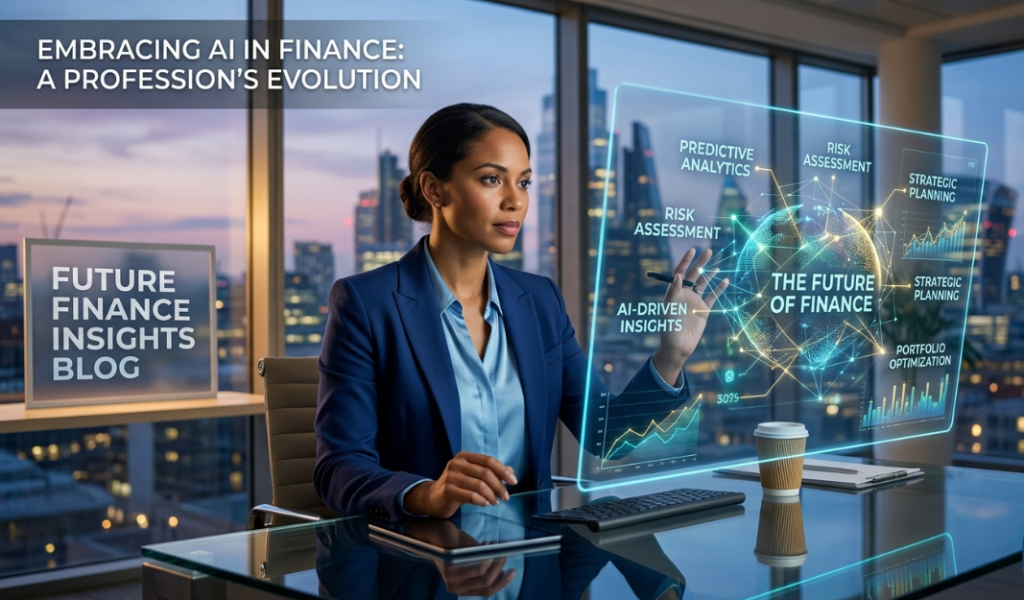
Introduction
Let’s not sugarcoat it—Artificial Intelligence (AI) is no longer just a trend. It’s reshaping entire industries, and finance is right at the center of this transformation.
From tools like ChatGPT to advanced machine learning algorithms, AI is changing how financial professionals analyze data, predict trends, and interact with clients. What used to take hours (or even days) can now be done in minutes—with more accuracy and deeper insights.
But here’s the real question:
👉 Is AI replacing finance professionals—or upgrading them?
Short answer? It’s upgrading them.
In this article, we’ll break down how AI in finance is evolving, what it means for your career, and—most importantly—how you can stay ahead in this fast-moving landscape.
The Shift: From Traditional Finance to AI-Powered Finance
Not too long ago, finance professionals relied heavily on spreadsheets, historical data, and manual analysis. While those skills are still relevant, they’re no longer enough.
Today, AI-powered finance tools can:
- Analyze massive datasets in seconds
- Detect hidden patterns in financial markets
- Automate repetitive financial tasks
- Improve financial forecasting accuracy
Technologies like machine learning in finance and deep learning algorithms are now doing the heavy lifting—freeing professionals to focus on strategy instead of routine work.
The result? Faster decisions, fewer errors, and smarter financial planning.
AI in Financial Services: Real-World Applications
Let’s get practical. AI isn’t just theory—it’s already being used across the financial sector.
1. Fraud Detection and Risk Management
AI systems can analyze transaction patterns in real time and flag suspicious behavior instantly.
- Detect unusual spending patterns
- Prevent fraud before it happens
- Improve compliance and security
👉 This is a game-changer for banks and fintech companies.
2. Predictive Analytics and Market Forecasting
AI excels at analyzing historical and real-time data to predict future trends.
- Stock market predictions
- Investment risk analysis
- Economic forecasting
While it’s not perfect, it’s significantly more powerful than traditional models.
3. Automated Financial Processes
Repetitive tasks? AI handles them.
- Invoice processing
- Account reconciliation
- Financial reporting
👉 This reduces human error and saves a lot of time.
4. Personalized Financial Services
AI allows companies to tailor services to individual users.
- Personalized investment advice
- Smart budgeting tools
- Customized financial products
This is where AI meets customer experience.
The Rise of Fintech and AI Innovation
You can’t talk about AI in finance without mentioning fintech.
Fintech startups are:
- Faster
- More agile
- More data-driven
They’re using AI to:
- Reduce operational costs
- Offer better user experiences
- Disrupt traditional banking models
And here’s the kicker—traditional institutions are now racing to catch up.
AI + Fintech = the future of financial innovation
AI + Blockchain: A Powerful Combination
Another major trend? The combination of AI and blockchain in finance.
Together, they create:
- More secure transactions
- Faster processing systems
- Transparent financial ecosystems
AI analyzes data, while blockchain ensures trust and security.
It’s a perfect match for modern financial systems.
Why AI Is a Game-Changer for Decision-Making
Let’s talk about something that really matters: better decisions.
AI helps finance professionals:
- Process complex financial data faster
- Reduce bias in decision-making
- Identify opportunities earlier
- Minimize risks
Whether you’re in:
- FP&A
- M&A
- Financial consulting
- Corporate finance
AI gives you a serious edge.
Key Benefits of AI in Finance
Here’s why companies are investing heavily in AI:
- Speed: Tasks that took hours now take minutes
- Accuracy: Fewer human errors
- Scalability: Handle large volumes of data effortlessly
- Automation: Reduce manual workload
- Predictability: Anticipate trends and risks
In short: more efficiency, more profit, less guesswork.
Essential AI Skills for Finance Professionals
Alright—this is where things get real.
If you want to stay relevant, you need to adapt.
1. Understanding AI Tools
You don’t need to be a data scientist—but you need to understand:
- How AI works
- Its limitations
- When to trust (or question) outputs
2. Prompting Skills (Yes, This Matters)
Knowing how to “talk” to AI tools is a superpower.
Use AI for:
- Financial analysis
- Report generation
- Scenario simulations
Better prompts = better results
3. Data Literacy
Data is the foundation of AI.
You should be able to:
- Read and interpret data
- Identify trends
- Validate data quality
4. AI Integration in Daily Tools
Tools like:
- Excel (with AI features)
- Power BI
- ERP systems
…are becoming smarter every day.
Learn how to use them with AI, not without it.
🔄 5. Automation Skills
Automate tasks like:
- Monthly reports
- Financial checks
- Data processing
This frees you up for strategic work.
6. Critical Thinking (More Important Than Ever)
Here’s the truth—AI isn’t always right.
You need to:
- Question outputs
- Spot inconsistencies
- Understand context
Human judgment is still irreplaceable.
Common Mistakes to Avoid
Even with all this power, people still mess it up:
- Blindly trusting AI outputs
- Ignoring data quality
- Over-automating critical decisions
- Not updating skills
AI is a tool—not a replacement for thinking.
The Future of AI in Finance
So, where is all this heading?
We’re moving toward:
- Fully automated financial systems
- Real-time decision-making
- Smarter investment strategies
- Hyper-personalized financial services
And honestly? We’re just getting started.
FAQs
Is AI replacing finance jobs?
No—it’s transforming them. Professionals who adapt will thrive.
What is the biggest advantage of AI in finance?
Speed and accuracy in data analysis and decision-making.
Do I need coding skills to use AI in finance?
Not necessarily. Many tools are user-friendly and require no coding.
How can I start learning AI for finance?
Start with online courses, practical tools, and real-world use cases.
Is AI reliable for financial decisions?
It’s powerful, but not perfect. Always combine AI insights with human judgment.
Final Thoughts
AI in finance isn’t something coming in the future—it’s already here.
The real difference-maker?
How you choose to use it.
You can ignore it and fall behind…
Or you can embrace it, learn it, and use it to become a smarter, faster, and more valuable professional.
Because in today’s world, it’s not about competing with AI.
It’s about working with it.