The world of Non-Fungible Tokens (NFTs) has exploded into the mainstream, transforming how we perceive ownership, value, and creativity in the digital age. Beyond the initial hype surrounding digital collectibles, NFTs are evolving into a sophisticated asset class with profound implications for the digital art market and beyond. For investors in Canada and the United States, understanding this new frontier—its concepts, opportunities, and inherent risks—is essential to navigating the financial landscape of 2025 and 2026. This comprehensive guide will explore the dynamic intersection of NFTs, digital art, and investment, offering insights tailored for North American portfolios.
Demystifying NFTs: More Than Just JPEGs
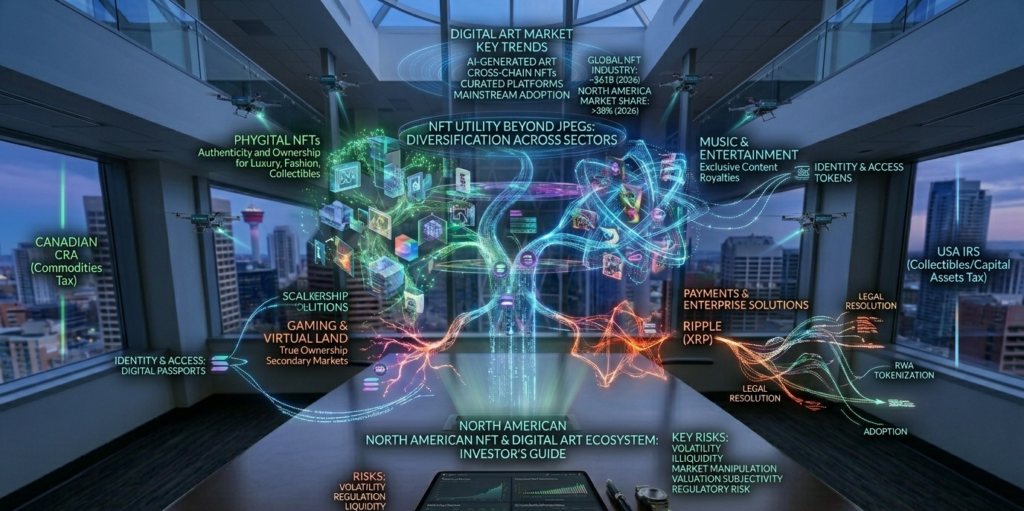
At its core, an NFT is a unique digital identifier recorded on a blockchain, proving ownership of a specific digital or physical asset. Unlike cryptocurrencies like Bitcoin, which are fungible (interchangeable), each NFT is distinct and cannot be replaced by another. While early adoption was heavily concentrated in digital art, the utility of NFTs has expanded dramatically.
The Evolution of NFT Utility:
•Digital Art & Collectibles: The most well-known application, where NFTs represent ownership of unique digital artworks, avatars, and collectibles.
•Gaming: NFTs are used for in-game assets, characters, and virtual land, enabling true ownership and secondary markets within virtual worlds.
•Music & Entertainment: Artists are using NFTs to offer exclusive content, fan experiences, and royalty distribution.
•Identity & Access: NFTs can serve as digital passports, membership tokens, or tickets, granting access to exclusive communities or events.
•Phygital NFTs: A growing trend where NFTs are linked to physical goods, providing digital authentication of authenticity and ownership for luxury items, fashion, and collectibles.
•NFT-as-a-Service (NaaS): Businesses are increasingly leveraging NaaS platforms to integrate NFTs into their loyalty programs, marketing campaigns, and supply chain management, indicating a maturing market beyond speculative trading.
The Digital Art Market: A North American Perspective (2025-2026)
The digital art market, largely powered by NFTs, has witnessed explosive growth and is projected to continue its upward trajectory. The global NFT industry was valued at approximately $43 billion in 2025 and is expected to reach around $61 billion in 2026. North America remains a dominant force, accounting for over 38% of the digital artwork market share in 2026.
Key Trends Shaping the Market:
•AI-Generated Art: The intersection of AI and digital art is creating new forms of artistic expression. AI tools are assisting artists in creation, and AI-generated NFTs are gaining cultural and market significance.
•Cross-Chain NFTs: Efforts to enable NFTs to move seamlessly between different blockchains (e.g., Ethereum, Solana, Polygon) are enhancing liquidity and expanding market reach.
•Curated Platforms: A shift towards more curated and exclusive platforms for high-value digital art, attracting traditional art collectors and institutions.
•Mainstream Adoption: Major brands, celebrities, and cultural institutions are increasingly entering the NFT space, bringing broader recognition and new use cases.
Investment Opportunities: Navigating the New Frontier
For Canadian and American investors, the NFT and digital art market offers unique investment avenues, distinct from traditional asset classes.
1. Blue-Chip NFTs & Established Collections
Similar to traditional art, certain NFT collections have achieved “blue-chip” status, characterized by strong brand recognition, historical significance, and a loyal community. Investing in these established collections can offer a degree of stability, though prices remain highly volatile.
2. Emerging Digital Artists & Platforms
Supporting emerging digital artists on platforms like SuperRare, Foundation, or Nifty Gateway can offer significant upside potential, albeit with higher risk. Identifying talent early and understanding artistic trends are crucial.
3. Infrastructure & Ecosystem Plays
Investing in the underlying technology and platforms that support the NFT ecosystem can be a less direct but potentially more stable approach. This includes tokens of blockchains optimized for NFTs (e.g., Flow, Immutable X), NFT marketplaces, and tools for NFT creation and management.
4. Fractionalized NFTs
Fractionalization allows investors to own a portion of a high-value NFT, making expensive pieces more accessible. This can lower the entry barrier and increase liquidity for certain assets.
Tax and Legal Implications: A North American Lens
Navigating the tax and legal landscape of NFTs is complex and evolving. Investors in Canada and the USA must be aware of their obligations.
United States (IRS)
The IRS generally treats NFTs as collectibles or capital assets, depending on their nature and how they are used. Sales of NFTs are taxable events. If an NFT is considered a collectible, it may be subject to a higher long-term capital gains tax rate (up to 28%). If it’s a capital asset, standard capital gains rates apply. The specific tax treatment can depend on whether the NFT is held for investment, used in a business, or acquired for personal use. Accurate record-keeping of purchase price, sale price, and transaction fees is critical.
Canada (CRA)
The Canada Revenue Agency (CRA) considers NFTs as commodities for income tax purposes, not legal currency. Any gain or loss from trading or selling NFTs is generally taxable. Depending on the frequency and intent of trading, these gains can be treated as business income (fully taxable) or capital gains (50% taxable). The CRA has published guidance to clarify the tax treatment of crypto-asset activities, emphasizing that taxpayers must report all income and gains from NFTs.
Legal Considerations:
•Intellectual Property: Ownership of an NFT typically confers ownership of the token itself, not necessarily the underlying intellectual property (copyright) of the digital art. This distinction is a significant area of ongoing legal debate and can impact the value and rights associated with an NFT.
•Fraud & Scams: The unregulated nature of parts of the NFT market makes it susceptible to scams, phishing, and intellectual property infringement. Due diligence is paramount.
Risks: The Volatile Nature of a New Asset Class
While the opportunities are compelling, investing in NFTs carries substantial risks:
•Extreme Volatility & Illiquidity: NFT prices can fluctuate wildly, often driven by sentiment and speculation. Many NFTs are highly illiquid, meaning they can be difficult to sell quickly without significantly impacting their price.
•Market Manipulation: The relatively small size of some NFT markets makes them vulnerable to manipulation, such as “wash trading” (buying and selling an asset to create artificial activity).
•Security Risks: The digital nature of NFTs makes them susceptible to hacking, phishing attacks, and smart contract vulnerabilities. Secure storage (e.g., hardware wallets) is crucial.
•Valuation Challenges: Unlike traditional assets, valuing NFTs can be highly subjective, relying on factors like artistic merit, community engagement, rarity, and historical sales data, which can be difficult to quantify.
•Regulatory Risk: Evolving regulations could impose restrictions or taxes that negatively impact the NFT market.
Strategic Considerations for North American Investors
To navigate this new frontier effectively, consider these strategies:
•Research and Due Diligence: Thoroughly investigate any NFT project, artist, or platform before investing. Understand the team, roadmap, community, and underlying technology.
•Understand Ownership Rights: Be clear about what rights you acquire when purchasing an NFT (e.g., display rights vs. commercial rights).
•Diversify: Do not over-allocate to NFTs. Treat them as a high-risk, high-reward component of a diversified portfolio.
•Security Best Practices: Use strong, unique passwords, enable two-factor authentication, and consider hardware wallets for storing valuable NFTs.
•Stay Informed on Regulations: Keep abreast of tax guidance from the IRS (USA) and CRA (Canada) and broader regulatory developments.
•Long-Term vs. Short-Term: Decide whether you are investing for long-term appreciation based on utility and cultural significance or for short-term speculative gains, and adjust your strategy accordingly.
Conclusion
NFTs and the digital art market represent a fascinating and potentially lucrative new frontier for investors in Canada and the United States. While the initial speculative frenzy may have subsided, the underlying technology and its applications continue to evolve, promising to reshape industries from art and gaming to identity and finance. By understanding the core concepts, recognizing the opportunities for innovative investment, and diligently managing the inherent risks, North American investors can strategically position themselves to explore and potentially thrive in this exciting new digital economy.
Protect your crypto from hackers using this

- All your digital assets in one place. You can manage thousands of crypto including Bitcoin, Ethereum, Solana, Tether and…
- Protect your digital assets with the industry’s best security: keep your private keys offline in your private signer, ba…
- Effortlessly build your crypto portfolio via the all in one Ledger Wallet app: buy, sell, send, receive, swap, stake and…
References
[1] Research Nester. (n.d.). NFT-as-a-Service Market Size & Share, Growth Trends 2035.
[2] Colexion. (2026, January 16). NFT Market Size & Growth Statistics (2026 Data & Trends).
[3] Coherent Market Insights. (n.d.). Digital Artwork Market Size and YoY Growth Rate, 2026-2033.
[4] Cosimo.art. (2026, April 9). Rise of Digital Art in 2026: AI, NFTs & Market Trends.
[6] TurboTax. (2026, January 27). How does buying an NFT affect my taxes?.
[8] Cryptact. (2026, February 9). Canada Crypto Tax Guide 2026: Complete CRA Compliance Checklist.