
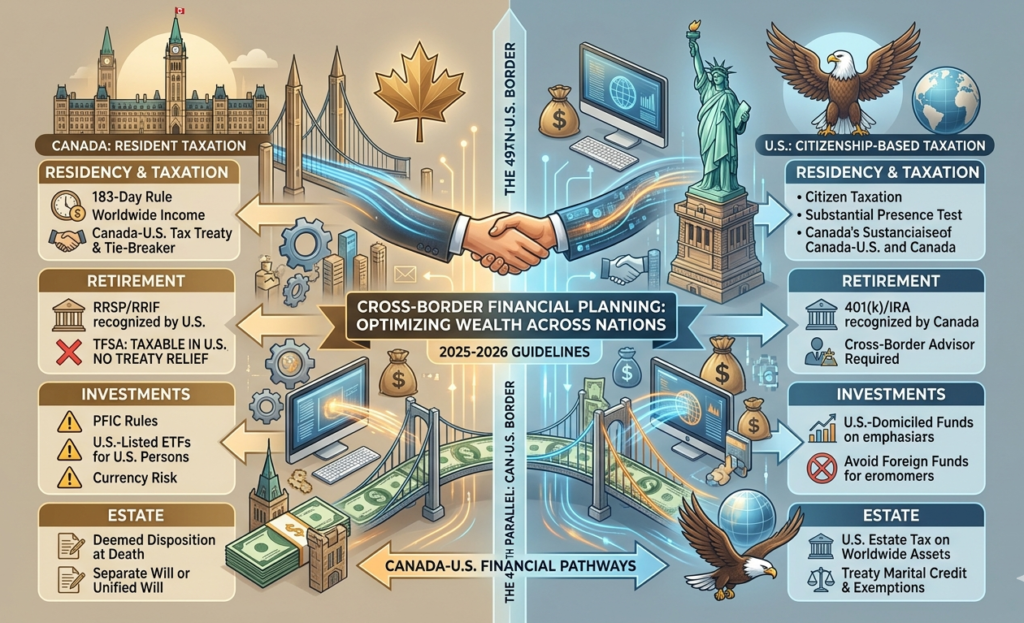
For the millions of individuals who live, work, or own assets across the Canada-U.S. border, financial planning takes on an added layer of complexity. Navigating two distinct tax systems, differing investment regulations, and unique retirement and estate planning rules can be daunting. However, with careful planning and expert guidance, Canadians and Americans can optimize their financial strategies to thrive in both nations. This comprehensive guide, tailored for 2025-2026, delves into the intricacies of cross-border financial planning, offering essential insights into taxation, retirement, investments, and estate considerations.
Understanding Cross-Border Residency and Taxation
The cornerstone of cross-border financial planning is understanding residency for tax purposes, as it dictates where and how your income and assets are taxed. The Canada-U.S. Tax Treaty is a critical tool designed to prevent double taxation and clarify tax obligations for individuals with ties to both countries.
Residency Rules:
•Canadian Residents: Generally, if you reside in Canada for 183 days or more in a calendar year, you are considered a Canadian resident for tax purposes. However, other factors like a permanent home, family, and economic ties can also establish residency.
•U.S. Residents: For U.S. tax purposes, residency can be established through citizenship, holding a Green Card, or meeting the “substantial presence test” (spending a certain number of days in the U.S. over a three-year period).
Key Tax Considerations:
•U.S. Citizenship-Based Taxation: Unlike most countries, the U.S. taxes its citizens on their worldwide income, regardless of where they reside. This means U.S. citizens living in Canada must file U.S. tax returns annually, even if they owe no U.S. tax due to foreign tax credits or exclusions.
•Canadian Taxation: Canada taxes its residents on their worldwide income. Non-residents are generally taxed only on Canadian-sourced income.
•The Canada-U.S. Tax Treaty: This treaty provides mechanisms to avoid double taxation, such as foreign tax credits and reduced withholding tax rates on certain types of income (e.g., dividends, interest) . It also contains a “tie-breaker rule” to determine residency if an individual is considered a resident of both countries under their respective domestic laws.
Retirement Planning Across the Border
Retirement savings vehicles differ significantly between Canada and the U.S., requiring careful planning to ensure tax efficiency and accessibility.
U.S. Retirement Accounts (401(k), IRA, Roth IRA):
•Moving to Canada: If you move from the U.S. to Canada, your U.S. 401(k) and IRA accounts are generally recognized by the Canada-U.S. Tax Treaty as tax-deferred. However, many U.S.-based advisors may not be licensed to manage these accounts for Canadian residents. Rolling funds into an IRA that can be managed by a cross-border advisor is often a practical solution.
•Reporting Requirements: U.S. persons (citizens or Green Card holders) in Canada must report their foreign financial accounts, including Canadian RRSPs, to the IRS via FBAR (Foreign Bank Account Report) and potentially Form 8938 (Statement of Specified Foreign Financial Assets) .
Canadian Retirement Accounts (RRSP, RRIF, TFSA):
•Moving to the U.S.: Registered Retirement Savings Plans (RRSPs) and Registered Retirement Income Funds (RRIFs) are generally recognized as tax-deferred by the U.S. under the treaty. However, specific reporting requirements apply for U.S. persons holding these accounts.
•Tax-Free Savings Accounts (TFSAs): Crucially, TFSAs are NOT recognized as tax-exempt by the IRS. For U.S. citizens or residents, income and gains within a TFSA are taxable in the U.S., and the account must be reported annually. This often makes TFSAs unsuitable for U.S. persons.
•Transfers: Direct rollovers between U.S. 401(k)s/IRAs and Canadian RRSPs are generally not possible without liquidating the U.S. account, incurring taxes and penalties.
Cross-Border Investment Strategies
Investing across the border introduces complexities related to tax efficiency, currency risk, and regulatory compliance.
Key Investment Challenges:
•Passive Foreign Investment Company (PFIC) Rules: For U.S. persons, Canadian mutual funds and ETFs are often classified as PFICs by the IRS. This can lead to extremely punitive tax treatment, making them highly undesirable. U.S.-listed ETFs are generally preferred for U.S. persons.
•Currency Risk: Managing assets in both Canadian Dollars (CAD) and U.S. Dollars (USD) requires careful consideration of currency fluctuations and potential hedging strategies.
•Brokerage Accounts: Finding a brokerage firm licensed to operate in both countries and handle cross-border accounts is essential.
Recommended Strategies:
•U.S.-Domiciled Investments: For U.S. persons, prioritizing U.S.-domiciled ETFs and mutual funds can avoid PFIC issues.
•Tax-Efficient Asset Location: Strategically place investments in accounts where they receive the most favorable tax treatment (e.g., growth-oriented investments in tax-deferred accounts).
•Professional Guidance: Work with a cross-border financial advisor who understands the nuances of both tax systems and investment regulations.
Estate Planning for Cross-Border Families
Estate planning becomes significantly more intricate when assets or beneficiaries are located in both Canada and the U.S. The interplay of estate taxes, probate laws, and succession rules requires meticulous attention.
Key Estate Considerations:
•U.S. Estate Tax: The U.S. imposes a federal estate tax on the worldwide assets of U.S. citizens and residents, with a high exemption threshold (e.g., over $13 million per individual in 2025). Non-U.S. citizens/residents are subject to U.S. estate tax only on their U.S.-situated assets, with a much lower exemption.
•Canadian Deemed Disposition: Canada does not have an estate tax. Instead, upon death, individuals are deemed to have disposed of all their capital property at fair market value, triggering capital gains tax. This is often referred to as a “departure tax” on death.
•Wills and Trusts: Having separate wills for assets in each country, or a single will carefully drafted to be valid and effective in both jurisdictions, is crucial. Cross-border trusts can be complex but may offer solutions for tax efficiency and asset protection.
Strategies for Cross-Border Estate Planning:
•Review Existing Documents: Ensure your wills, powers of attorney, and healthcare directives are valid and effective in both Canada and the U.S.
•Utilize the Tax Treaty: The Canada-U.S. Tax Treaty provides relief from U.S. estate tax for Canadian residents, often through a marital credit or prorated exemption.
•Professional Advice: Engage cross-border estate lawyers and tax specialists to create a comprehensive plan that minimizes taxes and ensures your wishes are fulfilled.
Essential Steps for Cross-Border Financial Success
Navigating the complexities of cross-border finances requires a proactive and integrated approach. Here are key steps to consider:
- Seek Specialized Advice: Work with financial planners, tax accountants, and lawyers who specialize in Canada-U.S. cross-border issues. Their expertise is invaluable in avoiding costly mistakes.
2. Understand Your Residency Status: Clarify your tax residency in both countries to ensure proper tax filing and compliance.
3. Optimize Retirement Accounts: Strategically manage your 401(k)s, IRAs, RRSPs, and TFSAs, being mindful of the tax implications in both jurisdictions. Avoid TFSAs if you are a U.S. person.
4. Invest Wisely: Be aware of PFIC rules for U.S. persons and choose investment vehicles that are tax-efficient in your specific cross-border situation.
5. Comprehensive Estate Planning: Develop an estate plan that addresses assets and beneficiaries in both countries, minimizing taxes and ensuring a smooth transfer of wealth.
6. Stay Informed: Tax laws and regulations can change. Regularly review your financial plan with your advisors to adapt to new developments.
Conclusion
Cross-border financial planning for Canadians and Americans is a multifaceted endeavor that demands a deep understanding of two distinct financial ecosystems. From navigating complex tax treaties and optimizing retirement savings to structuring investments and planning your estate, every decision has implications on both sides of the border. By taking a proactive approach, seeking specialized professional advice, and staying informed about the evolving regulatory landscape, individuals can effectively manage their wealth, mitigate risks, and build a secure financial future, no matter which side of the 49th parallel they call home.
References
[1] SmartAsset. (2026, March 31). Guide to Canada-U.S. Cross-Border Financial Planning.
[2] Greenback Tax Services. (n.d.). U.S. Expat Tax Guide for Living in Canada.
[3] IRS. (2026, January 3). United States income tax treaties – A to Z.
[4] Raymond James. (2026, April 27). Should You Roll Over a 401(k) to an IRA When Moving to Canada?.
[6] Plena Wealth. (n.d.). Cross-Border Retirement Planning | Manage IRA, 401(k), Roth IRA.
[8] Cardinal Point Wealth. (n.d.). Cross-Border Financial & Tax Planning.
[9] LinkedIn. (n.d.). Cross-Border Financial Planning: Essential Strategies for.
[10] RJLU. (2024, July 16). Wealth management checklist: Moving from the US to Canada.