
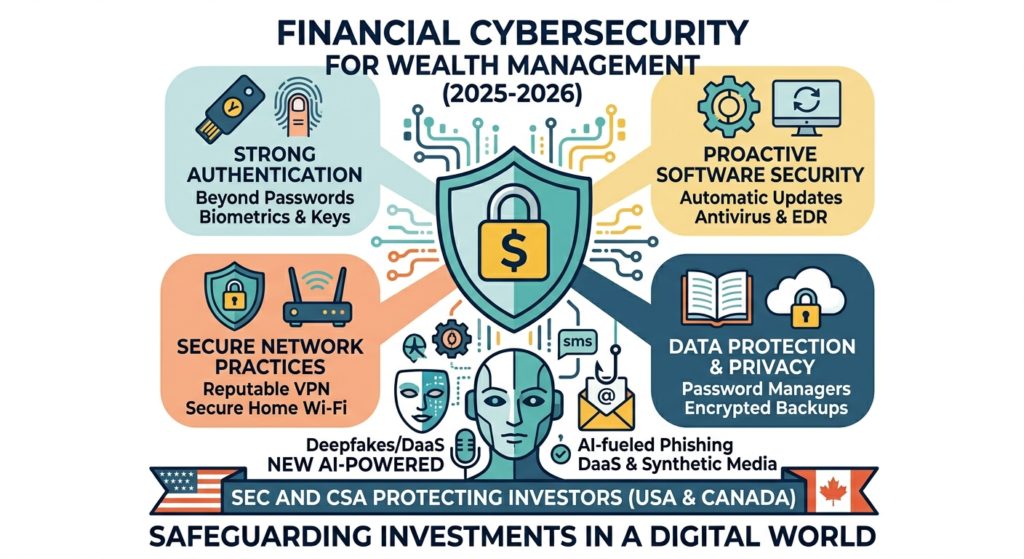
In an increasingly digital world, where financial transactions and personal data are constantly online, cybersecurity has become an indispensable aspect of wealth management. For investors and individuals in Canada and the United States, safeguarding investments and personal information from sophisticated digital threats is more critical than ever. As we look towards 2025 and 2026, the landscape of cybercrime is evolving rapidly, with new AI-powered tactics emerging. This comprehensive guide will equip you with the knowledge and tools to protect your financial assets and personal data from the latest digital threats, ensuring peace of mind in a connected world.
The Evolving Threat Landscape: AI-Powered Cybercrime (2025-2026)
Cybercriminals are leveraging advanced technologies, particularly Artificial Intelligence (AI), to create more convincing and scalable attacks. The traditional phishing email is being replaced by highly sophisticated, personalized scams that are difficult to detect.
Key Emerging Threats:
•AI-Fueled Phishing and Social Engineering: Generative AI can craft highly personalized and grammatically perfect phishing emails, text messages (smishing), and voice calls (vishing) that mimic legitimate sources. These campaigns are designed to trick individuals into revealing sensitive information or clicking on malicious links. In 2025, AI-generated phishing emails saw a staggering 72% open rate, nearly double that of traditional attempts.
•Deepfakes and Synthetic Media: AI-generated deepfake videos and audio are being used to impersonate executives, family members, or financial advisors. These can be used in CEO fraud schemes, where criminals trick employees into transferring funds, or in vishing attacks where a deepfake voice convinces victims to divulge account details. The FBI reported over 22,000 AI-related fraud complaints in 2025, with losses exceeding $893 million.
•Deepfake-as-a-Service (DaaS): The proliferation of DaaS platforms in 2025 has made sophisticated AI-powered attack tools accessible to a wider range of cybercriminals, significantly increasing the volume and complexity of attacks.
•Ransomware 2.0: Ransomware attacks are becoming more targeted and destructive, often coupled with data exfiltration, where sensitive data is stolen before encryption, adding an extra layer of extortion.
Why Financial Targets are Prime:
The financial sector remains a primary target for cybercriminals due to the high value of data and direct access to funds. In 2024, 53% of financial professionals reported deepfake scam attempts, highlighting the industry’s vulnerability. U.S. financial fraud losses alone rose to $12.5 billion in 2025, with AI-assisted attacks being a significant contributor.
Foundational Pillars of Financial Cybersecurity
Protecting your investments and personal data requires a multi-layered approach, combining robust technology with vigilant personal habits.
1. Strong Authentication: Beyond Passwords
Passwords alone are no longer sufficient. Implement strong, multi-factor authentication (MFA) everywhere possible.
•Hardware Security Keys (e.g., YubiKey, Google Titan): These physical devices offer the strongest form of MFA, making it nearly impossible for attackers to gain access even if they have your password.
•Authenticator Apps (e.g., Google Authenticator, Authy): Generate time-based one-time passwords (TOTP) that are more secure than SMS-based codes, which can be intercepted.
•Biometrics: Use fingerprint or facial recognition where available, but always ensure a strong fallback authentication method.
2. Proactive Software Security
Keeping your devices and software updated is a fundamental defense against cyber threats.
•Regular Updates: Enable automatic updates for your operating systems (Windows, macOS, iOS, Android), web browsers, and all applications. Software updates often include critical security patches for newly discovered vulnerabilities.
•Antivirus and Endpoint Detection & Response (EDR): Use reputable antivirus software and consider EDR solutions for more advanced threat detection and response, especially for business devices.
•Firewall: Ensure your operating system’s firewall is enabled and properly configured to control network traffic.
3. Secure Network Practices
How you connect to the internet significantly impacts your security posture.
•VPN (Virtual Private Network): Use a reputable VPN service, especially when connecting to public Wi-Fi networks, to encrypt your internet traffic and protect your data from eavesdropping.
•Secure Wi-Fi: Always use strong, unique passwords for your home Wi-Fi network and ensure it’s encrypted (WPA2 or WPA3).
•Avoid Public Wi-Fi for Sensitive Transactions: Never conduct banking, investing, or other sensitive transactions over unsecured public Wi-Fi.
4. Data Protection and Privacy
Your personal data is a valuable target. Protect it diligently.
•Password Managers: Use a password manager (e.g., 1Password, Bitwarden, Dashlane) to generate and store strong, unique passwords for all your accounts. This eliminates password reuse and reduces the risk of credential stuffing attacks.
•Data Encryption: Encrypt your devices (laptops, smartphones) to protect data in case of loss or theft.
•Regular Backups: Back up your important data regularly to an external drive or secure cloud service. This protects against data loss due to ransomware or hardware failure.
•Privacy Settings: Review and adjust privacy settings on social media, apps, and online services to limit the amount of personal information you share.
Practical Tips for Protecting Your Financial Life
Beyond technical measures, cultivating smart habits is your strongest defense.
1. Be Skeptical of Unsolicited Communications: Always verify the sender of emails, texts, or calls, especially if they request personal information, money, or urgent action. Even if it appears to be from a trusted source, be wary. Call the institution directly using a known, official phone number.
2. Monitor Your Accounts Regularly: Check your bank, credit card, and investment statements frequently for any unauthorized activity. Set up transaction alerts.
3. Use Strong, Unique Passwords: Never reuse passwords across different accounts. A password manager can help you manage complex, unique passwords effortlessly.
4. Enable Multi-Factor Authentication (MFA): Activate MFA on all financial accounts, email, and social media. Prioritize authenticator apps or hardware keys over SMS.
5. Be Wary of Public Wi-Fi: Avoid accessing sensitive financial information when connected to public, unsecured Wi-Fi networks.
6. Educate Yourself on Current Scams: Stay informed about the latest phishing, deepfake, and social engineering tactics. Resources from government agencies (e.g., the FTC in the US, the RCMP in Canada) and financial institutions often provide updates.
7. Shred Sensitive Documents: Properly dispose of physical documents containing personal or financial information.
8. Beware of “Too Good to Be True” Offers: Investment scams often promise unusually high returns with little to no risk. If it sounds too good to be true, it probably is.
Regulatory Oversight and Investor Protection (Canada and USA)
Both Canada and the U.S. have regulatory bodies dedicated to protecting investors and ensuring the integrity of financial markets. These bodies also focus on cybersecurity resilience within financial institutions.
•United States: The Securities and Exchange Commission (SEC) and the Financial Industry Regulatory Authority (FINRA) oversee investment firms and brokers, with increasing emphasis on cybersecurity disclosures and investor protection against digital fraud.
•Canada: The Canadian Securities Administrators (CSA) and the Investment Industry Regulatory Organization of Canada (IIROC) set standards for investment firms and work to protect investors from cyber threats and fraud.
Recommended Cybersecurity Tools for Investors
Equip yourself with the right tools to enhance your digital defenses.
| Tool Category | Recommended Options (2025-2026) | Key Benefits for Financial Security |
| Password Managers | 1Password, Bitwarden, Dashlane | Securely store and generate strong, unique passwords; autofill credentials; detect compromised passwords. |
| Hardware Security Keys | YubiKey, Google Titan Security Key | Provide phishing-resistant MFA, making it extremely difficult for attackers to access accounts. |
| Antivirus / EDR | Bitdefender, CrowdStrike, SentinelOne | Protect against malware, ransomware, and advanced persistent threats; offer real-time threat detection. |
| VPN Services | Mullvad, ProtonVPN, NordVPN | Encrypt internet traffic, hide IP address, protect data on public Wi-Fi, enhance online privacy. |
| Secure Email | ProtonMail, Tutanota | Encrypt internet traffic, hide IP address, protect data on public Wi-Fi, and enhance online privacy. |
| Secure Cloud Storage | Sync.com, pCloud, Tresorit | Encrypted cloud storage for sensitive documents and backups, offering robust privacy features. |
Conclusion
Financial cybersecurity is no longer an optional extra; it is a fundamental component of modern financial literacy. As digital threats become more sophisticated, driven by advancements in AI, a proactive and informed approach is essential for investors and individuals in Canada and the United States. By adopting strong authentication, maintaining software hygiene, practicing secure network habits, and leveraging recommended tools, you can significantly reduce your vulnerability to cybercrime. Protecting your investments and personal data is an ongoing commitment, but with the right strategies, you can navigate the digital landscape of 2025 and 2026 with confidence and security.
References
[1] World Economic Forum. (2026, March 31). 4 key steps to tackling AI-fuelled cyber fraud.
[2] SQ Magazine. (n.d.). AI Cyber Attacks Statistics 2026: How Attacks, Deepfakes &.
[3] CybelAngel. (2026, May 5). Deepfakes in 2026: How AI Fraud Targets US Organisations.
[4] Cyble. (2026, April 6). Deepfake-as-a-Service Exploded In 2025: 2026 Threats.
[5] ZeroThreat.AI. (2026, March 24). Deepfake Attacks & AI-Generated Phishing: 2026 Statistics.
[6] FINRA. (2026, February 3). Financial Security in 2026: Tips for Investors and How.
[7] Capital Credit Union. (2026, January 20). 2026 Guide to Cyber Security in Banking.