
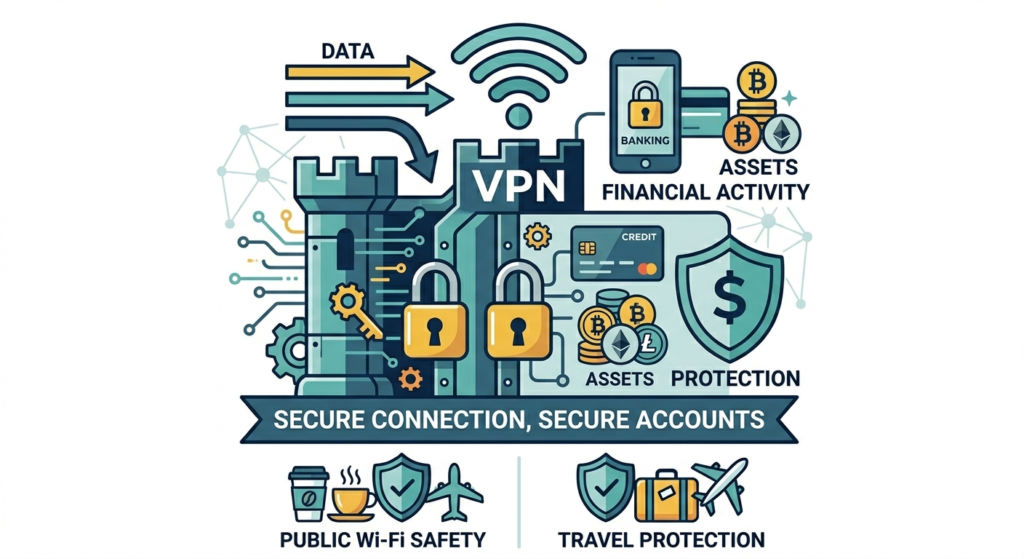
In today’s digital world, your financial life is online
From mobile banking and cryptocurrency wallets to investment platforms and online shopping, most of our financial activity now happens on the internet. But with convenience comes risk.
Cybercriminals constantly target users through unsecured Wi‑Fi networks, data interception, phishing attacks, identity theft, and account takeovers. Public networks in airports, cafés, hotels, and coworking spaces are especially vulnerable because many of them lack strong encryption and can expose sensitive information. [ftc.gov], [fcc.gov]
This is where a VPN becomes one of the most important tools for protecting your financial privacy and online security.
What Is a VPN?
A VPN (Virtual Private Network) creates an encrypted connection between your device and the internet.
In simple terms:
✅ It hides your IP address
✅ Encrypts your internet traffic
✅ Protects your personal and financial data
✅ Makes it harder for hackers to spy on your activity
When you use a VPN, your information travels through a secure “tunnel,” making it difficult for cybercriminals, internet providers, or malicious actors on public Wi‑Fi to intercept your data. [cyberguy.com], [nordvpn.com]
Why VPNs Matter for Financial Security
1. Protection on Public Wi‑Fi
Public Wi‑Fi is convenient — but dangerous.
According to the Federal Trade Commission (FTC), many public Wi‑Fi networks are not secure, which means strangers on the same network may potentially access sensitive information if proper protection is not in place. [ftc.gov], [govinfo.gov]
Imagine logging into:
- Your bank account
- PayPal
- Wealthsimple
- Online brokerage accounts
- Credit card portals
…while connected to airport Wi‑Fi.
Without a VPN, hackers may attempt:
- Packet sniffing
- Fake hotspot attacks (“evil twin” networks)
- Session hijacking
- Network spying
A VPN encrypts your traffic, dramatically reducing these risks. [techtimes.com], [media.defense.gov]
2. Extra Privacy for Your Banking Activity
Most banking websites already use HTTPS encryption, which is good news. However, a VPN adds another layer of privacy by masking your internet activity and IP address. [askleo.com], [dtptips.com]
Without a VPN:
- Your internet provider can often see which websites you visit
- Public networks may identify your banking activity
- Attackers may target users accessing financial platforms
With a VPN:
- Your browsing activity becomes harder to track
- Your real location is hidden
- Your connection gains another encrypted layer
3. Security While Traveling
If you travel frequently, a VPN becomes even more valuable.
Hotels, airports, cafés, and shared workspaces are common cyberattack environments. Government cybersecurity agencies warn that public wireless networks can expose users to malicious access points and traffic interception. [media.defense.gov], [fcc.gov]
A VPN helps secure:
- Travel banking
- International financial transactions
- Remote work access
- Crypto trading while abroad
Many users also use VPNs to connect through their home country while traveling to reduce suspicious login alerts from banks. [cyberguy.com], [finance-monthly.com]
When You SHOULD Use a VPN
Always use a VPN when:
✅ Using public Wi‑Fi
Especially at:
- Airports
- Hotels
- Coffee shops
- Libraries
- Shared coworking spaces
✅ Accessing banking or investment accounts
Particularly outside your home network.
✅ Traveling internationally
Protect your financial accounts while abroad.
✅ Working remotely
Especially if handling business payments or sensitive client information.
✅ Using cryptocurrency wallets or exchanges
Crypto accounts are major hacker targets.
When a VPN Alone Is NOT Enough
A VPN is powerful — but it is not magic.
A VPN cannot fully protect you from:
❌ Phishing websites
❌ Fake banking emails
❌ Weak passwords
❌ Malware infections
❌ Social engineering attacks
Experts emphasize that good digital habits are still essential. [biznettechnology.com], [nordvpn.com]
Best Practices for Financial Online Safety
To maximize your financial protection online:
Use a VPN + These Security Habits
🔒 Enable Two-Factor Authentication (2FA)
Adds an extra layer of login security.
🔒 Use Strong Unique Passwords
Never reuse banking passwords.
🔒 Avoid Clicking Unknown Links
Phishing scams are increasingly sophisticated.
🔒 Keep Devices Updated
Security patches matter.
🔒 Verify HTTPS Websites
Always check for the lock icon and “https://”. [ftc.gov], [govinfo.gov]
🔒 Avoid Free VPNs
Some free VPN providers log or sell user data.
How to Choose a Good VPN
Not all VPNs are trustworthy.
Look for these features:
✅ AES‑256 encryption
✅ No‑logs policy
✅ Kill switch protection
✅ Good reputation and transparency
✅ Fast, stable servers
✅ Multi-device support
Trusted paid VPN providers are generally safer than unknown free services.
Final Thoughts
Your financial security is no longer just about protecting your wallet — it’s about protecting your digital identity.
As cyber threats continue to grow, a VPN has become one of the smartest tools for anyone who banks, shops, invests, or works online.
Think of a VPN as a digital security layer:
- It won’t eliminate every risk
- But it significantly improves your online privacy and financial protection
In a world where data is currency, protecting your connection is protecting your money.
SEO Keywords
VPN security, online protection, financial privacy, secure banking, VPN for banking, cybersecurity, online financial security, public Wi‑Fi safety, digital privacy, financial data protection, safe online banking, VPN protection