
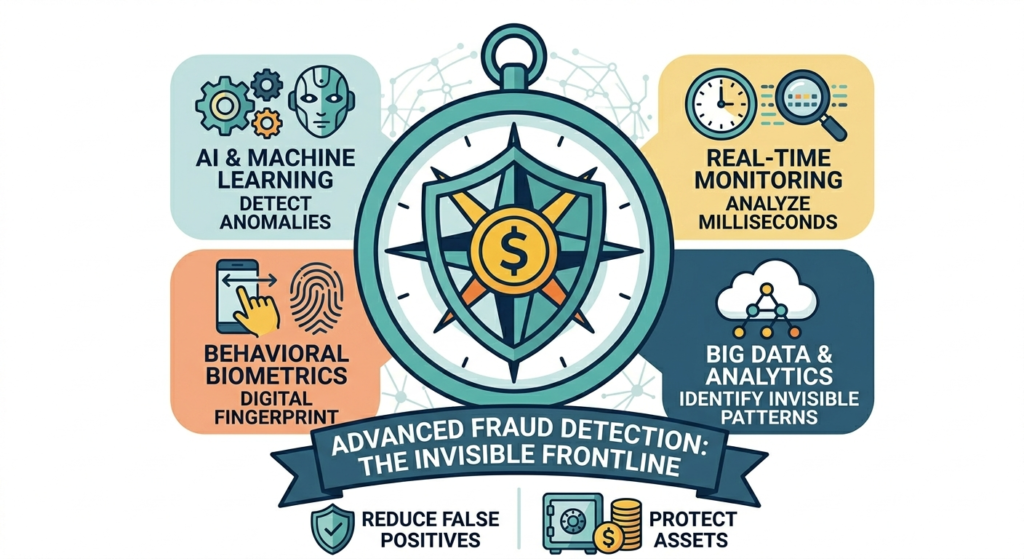
Financial fraud is evolving faster than ever
Banking has become increasingly digital — and so has financial crime.
Every day, cybercriminals attempt millions of fraudulent activities involving:
- Credit cards
- Online banking
- Wire transfers
- Investment accounts
- Mobile payment apps
- Cryptocurrency platforms
Modern fraud is no longer limited to stolen cards or suspicious emails. Today’s criminals use artificial intelligence, deepfakes, stolen identities, malware, phishing systems, and automated attacks to target both banks and customers. [forbes.com], [globalbank…inance.com]
To fight back, banks are investing billions into advanced fraud detection technologies powered by AI, machine learning, behavioral analytics, biometrics, and real-time monitoring systems. [backbase.com], [cyberproof.com]
Behind every declined suspicious transaction or fraud alert on your phone, there is an incredibly sophisticated security infrastructure working in milliseconds to protect your money.
What Is Financial Fraud Detection?
Financial fraud detection is the process banks use to identify suspicious behavior, unauthorized transactions, identity theft attempts, and criminal activity before money is stolen. [deliberate…ctions.com], [cyberproof.com]
Traditional banking systems once relied mostly on simple rule-based checks such as:
- Large transaction amounts
- Purchases from another country
- Multiple failed login attempts
But fraudsters evolved.
Modern criminals now design attacks specifically to bypass traditional rules by:
- Keeping transactions below alert limits
- Using VPNs and proxy servers
- Mimicking customer behavior
- Coordinating attacks across multiple accounts
Because of this, banks now depend heavily on intelligent technologies that can detect subtle anomalies in real time. [avenga.com], [aloa.co]
How Banks Use Artificial Intelligence to Detect Fraud
1. Real-Time Transaction Monitoring
One of the most important technologies banks now use is real-time AI transaction monitoring.
Every transaction is analyzed in milliseconds before approval. AI systems evaluate hundreds of variables simultaneously, including:
- Device information
- Login location
- Spending behavior
- Transaction history
- Time of day
- Merchant activity
- Account age
- Payment patterns
If something unusual appears, the transaction may be:
- Flagged
- Delayed
- Verified
- Declined automatically
This process happens almost instantly. [backbase.com], [cyberproof.com]
For example:
If a customer normally shops in Toronto and suddenly makes multiple large purchases from another country minutes later, the system may classify the behavior as high-risk.
AI systems continuously learn from new behavior patterns, making them far more adaptive than older rule-based systems. [avenga.com], [aloa.co]
Machine Learning: The Brain Behind Modern Fraud Prevention
Machine learning allows banking systems to improve over time without being manually reprogrammed for every new scam.
Instead of following static rules, machine learning models analyze enormous amounts of historical transaction data to understand what “normal” behavior looks like for each customer. [backbase.com], [deliberate …ctions.com]
This helps banks identify:
- Fraudulent transfers
- Account takeovers
- Synthetic identity fraud
- Unusual payment patterns
- Suspicious login behavior
Machine learning is especially powerful because criminals constantly change tactics. AI adapts much faster than traditional fraud systems. [aloa.co], [cyberproof.com]
Behavioral Biometrics: Your Habits Become Security
One of the most fascinating technologies in banking security today is behavioral biometrics.
Banks are increasingly analyzing how users interact with devices, including:
- Typing speed
- Finger pressure
- Mouse movement
- Swipe patterns
- Mobile phone handling
- Login rhythm
These behaviors create a unique digital fingerprint for each user. [journalajrcos.com], [cyberproof.com]
If someone suddenly logs into your account but types differently or interacts unusually with the app, the system may suspect fraud even if the password is correct.
This allows banks to detect account takeovers that traditional passwords alone might miss.
Facial Recognition and Biometric Authentication
Many banks now use biometric authentication methods such as:
- Fingerprint scanning
- Facial recognition
- Voice authentication
These technologies reduce dependency on passwords, which can be stolen or leaked in data breaches. [cyberproof.com], [globalbank… finance.com]
However, cybercriminals are also evolving.
Experts warn that deepfake technologies and AI-generated voices are becoming new fraud threats, forcing banks to strengthen biometric verification systems continuously. [aloa.co], [bankinfosecurity.com]
Big Data and Predictive Analytics
Modern fraud detection relies heavily on big data.
Banks process massive volumes of information every second:
- Customer activity
- Device connections
- Payment networks
- Merchant data
- Geolocation signals
- Risk indicators
AI analyzes these enormous datasets to identify invisible fraud patterns humans could never detect manually. [deliberate… com], [bankinfosecurity.com]
Predictive analytics can even estimate which accounts are more likely to experience fraud in the future, allowing banks to act proactively.
Why False Positives Are a Major Challenge
One hidden challenge banks face is balancing security with customer experience.
If fraud systems become too aggressive:
- Legitimate purchases get declined
- Customers become frustrated
- Businesses lose sales
If systems become too weak:
- Fraud increases
- Financial losses rise
- Customer trust declines
AI helps reduce false positives by improving decision accuracy and understanding customer behavior more intelligently. [backbase.com], [avenga.com]
This is why modern banks combine:
- AI automation
- Risk scoring
- Human investigators
- Real-time analytics
Instead of relying on a single security layer.
The Human Side Behind Fraud Detection
Despite all the technology, humans still play a critical role.
Fraud analysts investigate:
- High-risk alerts
- Organized fraud networks
- Complex money laundering schemes
- Identity theft rings
AI helps analysts prioritize the most dangerous threats instead of manually reviewing thousands of alerts. [forbes.com], [bankinfosecurity.com]
In many ways, modern banking security is now a partnership between humans and artificial intelligence.
What Customers Can Learn From Banking Security Systems
Banks invest heavily in cybersecurity because fraud is constantly evolving.
Consumers should adopt similar habits:
- Enable two-factor authentication
- Use strong passwords
- Monitor banking activity frequently
- Avoid suspicious links
- Protect devices with updates
- Be careful using public Wi‑Fi
- Verify emails and messages carefully
Technology helps — but user awareness remains essential.
Final Thoughts
Financial fraud has become smarter, faster, and more technologically advanced.
To keep up, banks are transforming cybersecurity through:
- Artificial intelligence
- Machine learning
- Behavioral biometrics
- Real-time monitoring
- Predictive analytics
- Advanced authentication systems
Most customers never see the complex infrastructure operating behind the scenes — but every transaction you make is likely being analyzed by sophisticated fraud detection technology within milliseconds.
As digital banking continues to grow, the battle between banks and cybercriminals will become even more advanced.
And in this invisible war, technology is the frontline defense protecting the global financial system.
SEO Keywords
fraud detection, banking technology, banking security, AI fraud detection, financial fraud prevention, cybersecurity banking, machine learning banking, banking cybersecurity, fraud prevention technology, online banking security, real-time fraud monitoring, financial cybersecurity, digital banking protection