
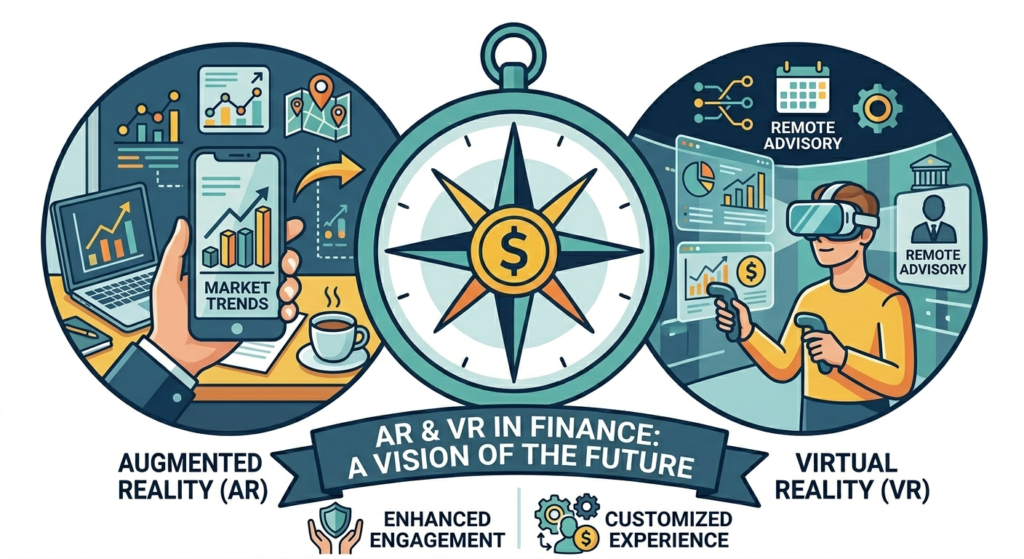
The financial sector is entering a new phase of digital transformation, and augmented reality (AR) and virtual reality (VR) are becoming part of that shift. What once seemed limited to gaming and entertainment is now being explored in banking, wealth management, insurance, financial education, employee training, and customer experience design. Research and industry analysis increasingly describe AR and VR as technologies capable of improving engagement, simplifying complex information, and creating new service models for financial institutions. [wjarr.com], [pwc.co.uk]
For finance, this matters because money is often abstract. Budgets, portfolios, risks, and long-term investment strategies are difficult for many people to visualize. AR and VR can make financial information more interactive, more intuitive, and easier to understand by turning numbers into immersive experiences rather than static dashboards. Industry experts and academic reviews point to this as one of the strongest reasons these technologies could become more relevant in the coming years. [wjarr.com], [forbes.com]
What AR and VR Mean in the Financial Sector
Augmented Reality (AR) overlays digital information onto the real world through smartphones, tablets, smart glasses, or other devices. In finance, this can mean viewing spending insights, account data, market trends, or branch navigation in a visual, interactive layer on top of the user’s real environment. [urapptech.com], [wjarr.com]
Virtual Reality (VR) creates a fully immersive digital environment. In financial services, VR can be used to simulate virtual branches, immersive advisory meetings, employee training environments, customer education, and collaborative financial planning scenarios. Several market and consulting sources note that VR is especially valuable where simulation, learning, and remote interaction are important. [hqsoftwarelab.com], [arthur.digital]
Together, AR and VR are often discussed as part of the broader extended reality ecosystem, where digital interfaces become more spatial, more interactive, and more personalized. For financial institutions, this opens the door to a future in which users do not just read their finances on a screen, but interact with them in a more visual and intuitive way. [pwc.co.uk], [qodequay.com]
Why AR and VR Could Matter So Much for Finance
Finance is built on trust, clarity, and decision-making. AR and VR have potential because they can improve all three. They can make complex products easier to explain, help customers engage more deeply with financial planning, and support staff training in a safer and more realistic environment. Academic and industry sources both highlight customer education, operational efficiency, and innovation as major drivers of adoption. [wjarr.com], [hqsoftwarelab.com]
Another reason is competitive pressure. Banks and financial institutions are already being pushed to create more personalized, digital-first experiences across channels. Consulting firms highlight that the future of banking will increasingly depend on customer engagement, personalization, and secure digital self-service. AR and VR fit naturally into that direction because they can turn standard digital interactions into more immersive experiences. [deloittedigital.com], [accenture.com]
How AR Could Transform Everyday Financial Services
One of the most practical AR use cases is data visualization. Instead of reading rows of transactions or static pie charts, users could point a phone at a bank statement or dashboard and instantly see spending patterns, savings progress, debt allocation, or portfolio performance as interactive 3D visuals. This makes personal finance less intimidating and more understandable, especially for users who struggle with traditional reports. [urapptech.com], [linkedin.com]
AR can also improve financial product exploration. Some industry analyses suggest that AR could help customers compare mortgages, loans, savings products, or insurance options through visual simulations. Instead of reading dense terms and tables, consumers could experience scenarios such as monthly payment changes, interest-rate impacts, or long-term savings outcomes in a more intuitive format. [urapptech.com], [qodequay.com]
Another practical use is location-based banking support. AR can help customers find nearby branches or ATMs, view hours, navigate facilities, and access contextual information in real time. While this may seem simple compared with immersive metaverse concepts, it represents the kind of useful, low-friction AR feature that could quietly improve customer experience at scale. [urapptech.com], [clustox.com]
How VR Could Reshape Banking and Investment Experiences
VR’s most talked-about application in finance is the concept of the virtual branch. Instead of visiting a physical location, customers could enter a digital banking environment from home, speak with advisors, review products, and attend consultations in a more immersive setting than a standard video call. Commentators and sector analyses argue that this model could be especially relevant for premium banking, wealth management, or advisory-led services where experience and trust matter. [linkedin.com], [forbes.com]
In wealth management and investing, VR could create immersive portfolio experiences. Rather than reviewing market data through conventional dashboards, investors and advisors could interact with simulated environments that represent risk exposure, asset allocation, or future scenarios. This may help clients understand volatility, diversification, and long-term strategy more clearly, especially when financial planning becomes emotional or complex. [hqsoftwarelab.com], [wjarr.com]
VR also creates opportunities for remote financial education. Workshops on retirement planning, debt management, investing basics, or insurance literacy could be delivered in virtual environments that are more engaging than standard webinars. The academic literature suggests that AR and VR can democratize financial education by making learning more interactive and easier to absorb. [wjarr.com], [wjarr.com]
Behind the Scenes: Where Banks and Financial Firms May See the Biggest Value First
While headlines often focus on futuristic customer experiences, one of the strongest short-term use cases may be employee training. VR allows financial institutions to simulate sensitive, complex, or high-pressure situations in a controlled environment. This includes branch interactions, client conversations, fraud scenarios, compliance situations, or operational disruptions. Training in virtual environments can reduce risk while giving employees more realistic practice. [hqsoftwarelab.com], [arthur.digital]
This is not just theory. PwC has been widely referenced for its work with VR training, managing large deployments of headsets, and training thousands of employees. Reports around PwC’s experience indicate VR can be highly engaging, scalable, and effective for immersive learning, especially when emotional connection and confidence-building are important. [arborxr.com], [arthur.digital]
For financial institutions, this matters because regulation, customer trust, and service quality all depend heavily on human performance. If VR can improve training outcomes in areas like communication, judgment, empathy, and compliance, its impact could be significant even before customer-facing metaverse banking becomes mainstream. [arborxr.com], [blog. 3spin… arning.com]
The Strategic Opportunity for Wealth Management
Wealth management may become one of the most promising areas for AR and VR adoption. High-net-worth clients often expect personalized service, deep advisory conversations, and sophisticated visualization of risk and opportunity. Immersive technologies could enhance these experiences by allowing advisors to present financial plans, estate strategies, investment projections, and scenario analysis in a more compelling format. [forbes.com], [deloittedigital.com]
This could also create a hybrid model where physical and digital experiences work together. A client might begin with a mobile AR overview of their portfolio, continue to a VR advisory meeting, and then receive follow-up recommendations through traditional digital banking channels. In this sense, AR and VR are not replacements for existing channels, but higher-value layers that could sit on top of them. [pwc.co.uk], [deloittedigital.com]
The Challenges Slowing Adoption
Despite the excitement, AR and VR in finance are still early-stage technologies with real limitations. Financial institutions have to evaluate hardware costs, user adoption barriers, cybersecurity risks, compliance concerns, privacy implications, and accessibility issues. Academic reviews of AR and VR in financial services emphasize that integration must be strategic, ethical, and aligned with regulation. [wjarr.com], [wjarr.com]
There is also the challenge of practicality. Many customers still prefer mobile apps, websites, phone support, or face-to-face advice. Not every financial interaction needs immersion. This means financial institutions will likely adopt AR and VR selectively, focusing on use cases where the technology clearly improves understanding, efficiency, or trust rather than deploying it for novelty alone. [forbes.com], [accenture.com]
Another issue is governance. As immersive technologies evolve alongside broader metaverse concepts, firms must think about security, controls, reporting, identity, and digital trust. PwC’s metaverse work repeatedly emphasizes that innovation without trust is not enough, especially in regulated sectors like finance. [pwc.com], [pwc.co.uk]
What the Future Could Look Like
The long-term future of AR and VR in finance will likely be gradual rather than explosive. The most probable path is not an overnight transformation into fully virtual banking, but step-by-step adoption in targeted areas such as training, advisory services, financial education, data visualization, and premium customer engagement. Industry commentary suggests that as hardware improves and immersive experiences become more accessible, adoption may become more practical across financial services. [hqsoftwarelab.com], [pwc.co.uk]
If that happens, the financial experience of the future may look very different from today’s flat interfaces. Customers could explore investment options in 3D, meet advisors in virtual environments, see budgets projected in real time through AR, and experience financial education in ways that feel more human, visual, and memorable. What matters most is not the novelty of the technology, but whether it helps people understand money better and make smarter decisions. [urapptech.com], [wjarr.com]
Final Thoughts
Augmented reality and virtual reality are not yet mainstream in finance, but they are no longer theoretical. Banks, consultancies, researchers, and technology firms are already exploring how immersive experiences could improve customer engagement, employee training, financial education, and advisory services. The direction is clear: financial services are becoming more digital, more visual, and more experience-driven. [wjarr.com], [pwc.com]
The real future of AR and VR in finance is not about replacing trust with technology. It is about using technology to make trust, clarity, and personalization stronger. For banks, investment firms, insurers, and fintech companies, the institutions that learn how to use immersive tools wisely may be the ones best positioned to define the next era of financial experience.