
Artificial Intelligence (AI) is rapidly transforming the financial landscape, offering unprecedented opportunities for efficiency, personalization, and predictive power. From algorithmic trading and fraud detection to personalized financial advice and credit scoring, AI is reshaping how financial services are delivered and consumed. However, this technological revolution comes with a complex web of ethical considerations that demand careful navigation. For financial institutions, regulators, and consumers in Canada and the United States, the challenge lies in balancing innovation with responsibility. This comprehensive post delves into the ethical dilemmas posed by AI in finance, explores the emerging regulatory frameworks for 2025-2026, and discusses how the industry can foster a future where AI serves humanity ethically and equitably.
The Dual Nature of AI in Finance: Promise and Peril
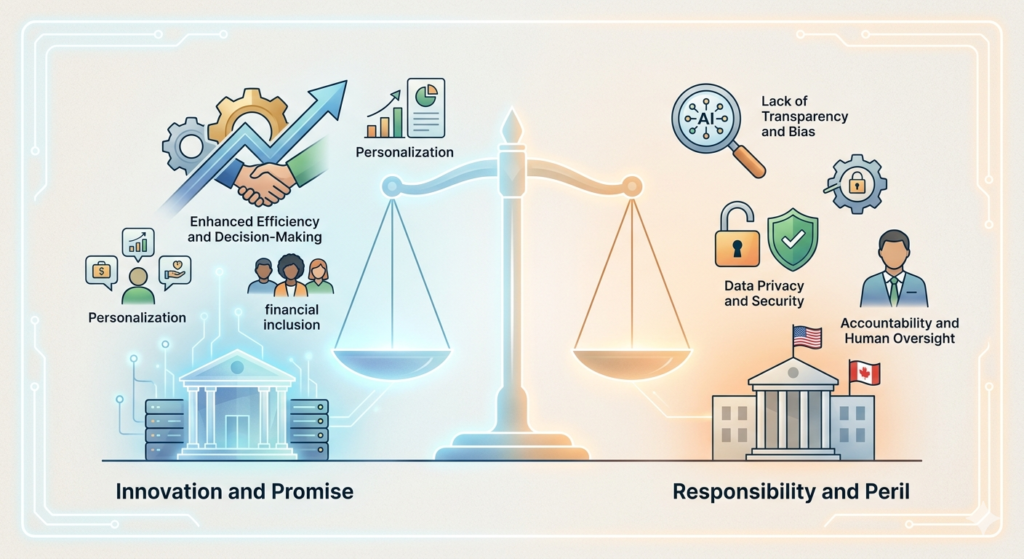
AI’s ability to process vast datasets, identify complex patterns, and automate decision-making brings immense benefits to the financial sector. Yet, these very capabilities also introduce significant ethical risks.
The Promise of AI:
•Enhanced Efficiency: Automating repetitive tasks, reducing operational costs, and speeding up processes like loan applications and customer service.
•Improved Decision-Making: AI can analyze more data points than humans, leading to more informed investment strategies, risk assessments, and fraud detection.
•Personalization: Offering tailored financial products, services, and advice to individual customers based on their unique profiles and needs.
•Financial Inclusion: Potentially expanding access to credit and financial services for underserved populations by using alternative data points.
The Peril: Ethical Dilemmas and Challenges:
1.Algorithmic Bias and Discrimination: AI models are trained on historical data, which often reflects societal biases. If not carefully managed, AI can perpetuate and even amplify these biases in critical financial decisions, leading to discriminatory outcomes in credit scoring, loan approvals, and insurance pricing . This can disproportionately affect minority groups or low-income individuals.
2. Lack of Transparency and Explainability (The “Black Box” Problem): Many advanced AI models, particularly deep learning networks, operate as “black boxes,” making it difficult to understand how they arrive at a particular decision. This lack of explainability poses challenges for accountability, regulatory oversight, and consumer trust, especially when a loan is denied or an investment decision is made by an algorithm.
3. Data Privacy and Security: AI systems require massive amounts of personal and financial data for training and operation. This raises significant concerns about data collection, storage, usage, and the potential for breaches or misuse. Ensuring robust data governance and privacy protection is paramount.
4. Accountability and Liability: When an AI system makes a flawed or harmful financial decision, determining who is ultimately responsible—the developer, the deploying institution, or the AI itself—becomes a complex legal and ethical question.
5. Job Displacement: The automation driven by AI could lead to significant job displacement in certain financial roles, raising societal concerns about economic inequality and the need for workforce retraining.
6. Systemic Risk: Over-reliance on similar AI models across the financial system could create new forms of systemic risk, where a flaw or bias in one widely adopted algorithm could trigger widespread market instability.
Navigating the Regulatory Landscape: 2025-2026 Outlook
Governments and regulatory bodies in North America are actively grappling with how to govern AI in finance, seeking to foster innovation while mitigating risks. The period of 2025-2026 is critical for the development and implementation of these frameworks.
United States:
•Treasury Department Frameworks: The U.S. Treasury Department is releasing resources to guide AI use in financial services, establishing a common language for AI and tailored frameworks for managing AI risks.
•CFPB Guidance: The Consumer Financial Protection Bureau (CFPB) has issued guidance emphasizing that lenders using AI must provide specific and accurate reasons for credit denials, addressing the transparency challenge.
•Cross-Agency Collaboration: Various agencies (SEC, FINRA, OCC) are collaborating to develop consistent approaches to AI oversight, focusing on consumer protection, market integrity, and financial stability.
Canada:
•OSFI’s Agile Framework: The Office of the Superintendent of Financial Institutions (OSFI) is adopting an “AGILE” framework to address AI risks and opportunities in Canadian financial services, recognizing the need for flexible regulation in a rapidly evolving field.
•Privacy as a Driver: Canada’s robust privacy laws are a primary driver for AI regulation, with a strong emphasis on data protection and consent. Public sector procurement is also emerging as a de facto standard-setting mechanism.
•Jurisdictional Complexity: Canada’s financial sector regulation spans 14 jurisdictions, creating a complex matrix of guidelines and legislation that requires careful navigation for AI deployment.
Emerging Global Principles:
Globally, there’s a growing consensus around principles for responsible AI, including fairness, accountability, transparency, safety, and privacy. These principles are influencing national regulatory approaches.
Building a Framework for Responsible AI in Finance
To harness the power of AI ethically, financial institutions must adopt comprehensive frameworks that embed ethical considerations throughout the AI lifecycle.
Key Pillars of Responsible AI:
1. Fairness by Design: Actively identifying and mitigating biases in data and algorithms from the outset. This involves diverse data sets, bias detection tools, and regular audits of AI models for discriminatory outcomes.
2. Transparency and Explainability (XAI): Developing “explainable AI” (XAI) techniques that allow for a clear understanding of how AI models make decisions. This is crucial for regulatory compliance, internal governance, and building customer trust.
3. Human Oversight and Accountability: Ensuring that AI systems operate under meaningful human control. This means humans remain “in the loop” for critical decisions, with clear lines of accountability for AI-driven outcomes.
4. Robust Data Governance: Implementing stringent policies for data collection, storage, usage, and deletion, ensuring compliance with privacy regulations (e.g., GDPR, CCPA, PIPEDA).
5. Security and Resilience: Protecting AI systems from cyber threats, manipulation, and adversarial attacks that could compromise their integrity or lead to erroneous decisions.
6. Ethical AI Culture: Fostering a culture within financial institutions that prioritizes ethical considerations, provides training for employees, and encourages open dialogue about AI’s societal impact.
The Debate: Innovation vs. Responsibility
The tension between accelerating innovation and ensuring responsible deployment is at the core of the AI ethics debate in finance. While rapid innovation can bring competitive advantages and new services, neglecting ethical considerations can lead to significant reputational damage, regulatory penalties, and erosion of public trust.
•Proponents of Innovation: Argue that overly stringent regulations could stifle technological progress, hinder competitiveness, and prevent the financial sector from realizing AI’s full benefits.
•Advocates for Responsibility: Emphasize that the potential for harm, particularly to vulnerable populations, necessitates a cautious approach, robust safeguards, and clear regulatory boundaries.
The sweet spot lies in agile governance—frameworks that are flexible enough to adapt to rapid technological change while providing clear ethical guardrails. This involves continuous dialogue between innovators, ethicists, policymakers, and civil society.
Conclusion
Artificial Intelligence is an undeniable force reshaping the future of finance. Its capacity for innovation is immense, promising more efficient, personalized, and intelligent financial services. However, the journey into an AI-driven financial future must be guided by a strong ethical compass. For institutions and individuals in Canada and the United States, understanding and actively addressing the ethical dilemmas of algorithmic bias, transparency, data privacy, and accountability is paramount. By embracing responsible AI frameworks, fostering an ethical culture, and engaging in constructive dialogue with regulators, the financial industry can ensure that AI serves as a powerful tool for progress, balancing the pursuit of innovation with an unwavering commitment to responsibility and societal well-being. The ethical integration of AI is not just a regulatory hurdle; it is a strategic imperative for long-term trust and sustainable growth in the financial sector.
References
[1] Lexology. (2026, January 27). AI Trends For 2026 – AI and Algorithmic Bias in Financial.
[2] RSIS International. (n.d.). The Ethics of AI in Financial Planning: Bias, Transparency.
[5] OSFI. (2026, March 23). FIFAI II: AI Risks and Opportunities: Adopting an AGILE.
[7] AIHub. (2026, March 4). Top AI ethics and policy issues of 2025 and what to expect in.