
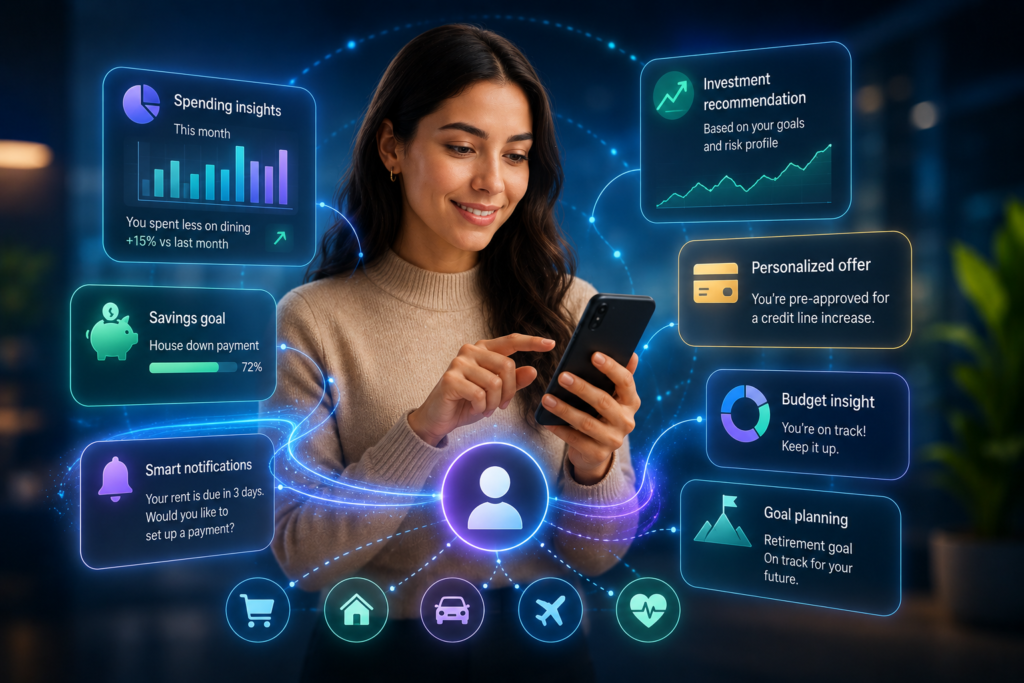
In the rapidly evolving landscape of financial services, a one-size-fits-all approach is becoming obsolete. Today, consumers in Canada and the United States expect financial experiences that are as unique as they are—tailored to their individual needs, behaviors, and aspirations. This shift is driven by hyper-personalization, a sophisticated application of technology that leverages vast amounts of data, artificial intelligence (AI), and real-time analytics to create bespoke financial journeys for every user. As we look towards 2025 and 2026, hyper-personalization is not just a trend; it’s becoming the industry standard, redefining how fintech companies and traditional banks engage with their customers. This comprehensive post will explore the drivers, benefits, key technologies, and future outlook of hyper-personalization in finance, highlighting how it’s crafting truly unique experiences.
The Evolution of Personalization: From Segments to Individuals
Historically, financial institutions segmented customers into broad categories, offering standardized products and services. The digital age brought basic personalization, like addressing customers by name. Hyper-personalization takes this a significant step further, moving beyond segments to treat each customer as an individual with unique financial DNA.
What is Hyper-Personalization?
Hyper-personalization is the delivery of highly relevant, individualized content, products, and services to customers in real-time, based on their explicit and implicit data. It’s about understanding a customer’s context, preferences, and behaviors at a granular level to anticipate their needs and offer proactive solutions.
The Driving Forces Behind Hyper-Personalization (2025-2026)
Several technological advancements and market demands are accelerating the adoption of hyper-personalization in finance.
1. Artificial Intelligence (AI) and Machine Learning (ML):
AI and ML algorithms are the engines of hyper-personalization. They analyze massive datasets—transaction history, spending patterns, credit scores, online behavior, and even social media activity (with consent)—to build comprehensive customer profiles. This allows for:
•Predictive Analytics: Anticipating future financial needs, such as saving for a down payment or planning for retirement.
•Behavioral Insights: Understanding spending habits, risk tolerance, and investment preferences to offer relevant advice and products.
•Real-time Recommendations: Delivering personalized offers or alerts at the precise moment they are most relevant to the user.
2. Big Data Analytics:
The sheer volume, velocity, and variety of data generated by digital interactions provide the raw material for hyper-personalization. Advanced analytics tools can extract meaningful insights from this data, enabling financial institutions to understand customer journeys in unprecedented detail.
3. Open Banking and API Economy:
In Canada, Open Banking momentum is accelerating, allowing customers to securely share their financial data with third-party providers. This fosters an ecosystem where fintechs can access a broader range of data (with user consent) to offer more integrated and personalized services. The API (Application Programming Interface) economy facilitates seamless data exchange between different financial platforms.
4. Enhanced User Experience (UX) Expectations:
Consumers, accustomed to highly personalized experiences from tech giants like Netflix and Amazon, now expect the same level of tailored interaction from their financial providers. Fintech UX trends for 2026 emphasize clarity, trust, and personalization, moving beyond mere features to focus on how confident users feel managing their money.
How Hyper-Personalization is Crafting Unique User Journeys
Hyper-personalization manifests in various ways, transforming every touchpoint of the financial journey.
Examples of Hyper-Personalization in Action:
| Area of Finance | Hyper-Personalized Experience | Technology Behind It |
| Personal Financial Management | Real-time alerts on unusual spending, personalized budgeting advice, automated savings goals based on income/expenses. | AI-driven behavioral analytics, predictive modeling. |
| Investment Advice | Tailored portfolio recommendations based on individual risk tolerance, financial goals, and life events; automated rebalancing. | Robo-advisors, AI-powered portfolio optimization algorithms. |
| Lending and Credit | Pre-approved loan offers with customized terms, dynamic credit limits, adaptive lending decisions based on holistic financial data. | AI-driven credit scoring, alternative data analysis. |
| Customer Service | AI-powered chatbots providing instant, context-aware support; proactive outreach based on anticipated needs; personalized product suggestions during interactions. | Natural Language Processing (NLP), AI-driven CRM systems. |
| Fraud Detection | Behavioral biometrics monitoring unique user interaction patterns to detect anomalies and prevent account takeover in real-time. | Machine learning, behavioral analytics. |
| Product Recommendations | Suggesting relevant financial products (e.g., specific credit cards, insurance policies) at optimal moments based on life stage and spending habits. | AI-driven recommendation engines, real-time data processing. |
Source: Deloitte, Finastra, MX Technologies
Benefits for Consumers and Financial Institutions
Hyper-personalization offers a win-win scenario for both sides of the financial equation.
For Consumers:
•Increased Relevance: Financial products and advice are directly applicable to their situation, leading to better financial outcomes.
•Enhanced Engagement: A more intuitive and responsive experience fosters greater interaction and loyalty.
•Financial Wellness: Tools and insights that help users manage their money more effectively, save more, and reduce debt.
•Time Savings: Streamlined processes and proactive solutions reduce the need for manual research or complex decision-making.
For Financial Institutions:
•Higher Customer Loyalty and Retention: Personalized experiences lead to more satisfied customers who are less likely to switch providers.
•Increased Revenue: Targeted product offerings and cross-selling opportunities drive higher conversion rates.
•Operational Efficiency: Automation of routine tasks and improved decision-making reduce costs.
•Competitive Advantage: Hyper-personalization becomes a key differentiator in a crowded market, especially against traditional banks that are slower to adapt.
•Improved Risk Management: A better understanding of customer behavior can aid in fraud detection and credit risk assessment.
The Road Ahead: Challenges and the Future (2025-2026)
While the benefits are clear, the journey to full hyper-personalization is not without its challenges.
Key Challenges:
•Data Privacy and Trust: Consumers must trust that their data is being used responsibly and securely. Transparency in data usage and robust privacy safeguards are crucial.
•Regulatory Compliance: Navigating complex and evolving data privacy regulations (e.g., PIPEDA in Canada, various state laws in the US) while implementing personalized strategies.
•Technological Integration: Integrating disparate data sources and legacy systems to create a unified customer view is a significant technical hurdle for many traditional banks.
•Ethical AI: Ensuring that AI algorithms used for personalization are fair, unbiased, and explainable to avoid discriminatory outcomes.
Future Outlook for 2026:
•Human-First Banking: The trend will shift from merely customer-centric to human-centric, focusing on emotional intelligence and empathetic AI to understand and respond to users’ emotional states.
•Generative AI as a Game-Changer: Generative AI will enable even more dynamic and context-aware personalized content, from financial reports to investment insights.
•Adaptive Interfaces: User interfaces will become even more adaptive, changing dynamically based on individual user behavior, preferences, and even mood.
•Wellness Services Integration: Financial services will increasingly integrate with broader wellness platforms, offering holistic advice that connects financial health with physical and mental well-being.
Conclusion
Hyper-personalization is fundamentally reshaping the financial services industry, moving beyond generic offerings to create truly unique and engaging experiences for every user. Driven by advancements in AI, big data, and open banking, this technological shift offers immense benefits for both consumers and financial institutions in North America. While challenges related to data privacy, regulation, and ethical AI remain, the trajectory towards a hyper-personalized financial future is clear. By embracing these innovations responsibly, financial providers can build deeper relationships with their customers, foster greater financial wellness, and secure a competitive edge in the dynamic markets of 2025 and 2026. The future of finance is personal, and technology is the craftsman behind every unique journey.
References
[1] MX Technologies. (n.d.). 6 Financial Services Predictions for 2026.
[4] Deloitte. (n.d.). Hyperpersonalization in the age of HPC.
[5] Finastra. (2026, February 24). AI in banking and financial services: Trends for 2026.
[6] LinkedIn. (2026, January 14). Hyper-Personalization at Bank Scale: A Governance Problem to.
[7] Datos Insights. (n.d.). 2026 Top Trends in Financial Services & Insurance.