
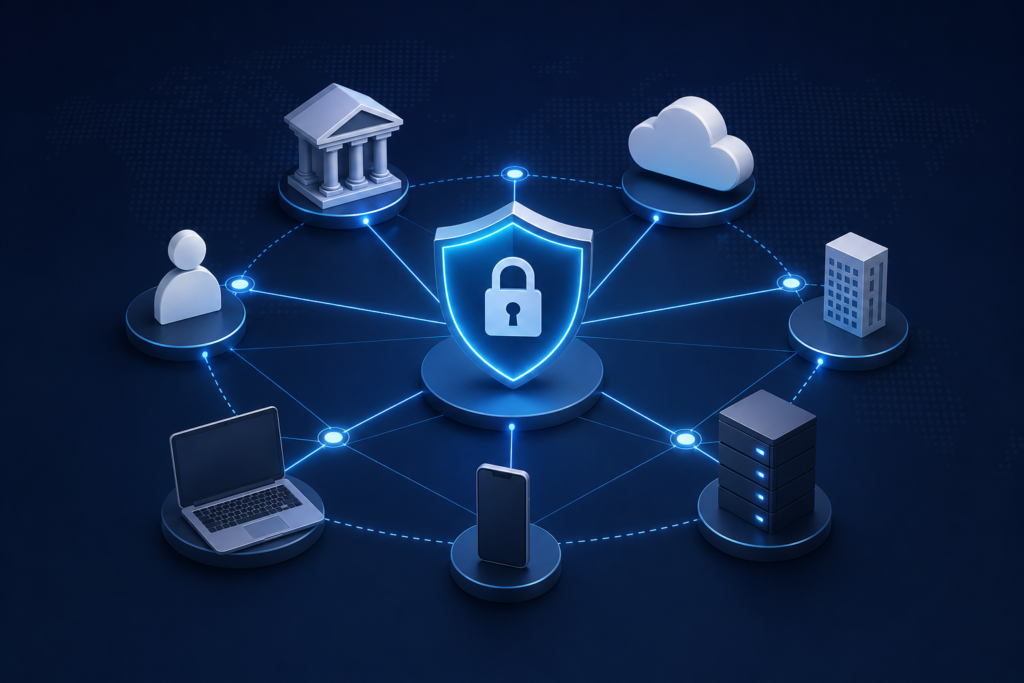
In an era where financial transactions are increasingly digital, global, and distributed, traditional perimeter-based cybersecurity models are no longer sufficient. The financial sector, a prime target for sophisticated cyber threats, demands a more resilient, adaptable, and integrated approach to protection. Enter Cybersecurity Mesh Architecture (CSMA), a revolutionary framework that is rapidly becoming the new standard for safeguarding complex financial ecosystems. For institutions and investors across Canada and the United States, understanding CSMA is crucial for navigating the evolving threat landscape of 2025-2026. This comprehensive post will delve into the core concepts of CSMA, its profound benefits for financial services, its relationship with Zero Trust principles, and how it’s reshaping the future of digital security.
The Limitations of Traditional Security and the Rise of CSMA
Historically, cybersecurity focused on building strong perimeters around an organization’s network. However, with the proliferation of cloud computing, remote work, mobile devices, and interconnected third-party services, the traditional perimeter has dissolved. This distributed environment creates numerous entry points for attackers and makes it challenging to maintain consistent security policies.
CSMA addresses these challenges by shifting from a centralized, monolithic security approach to a decentralized, collaborative one. Gartner defines CSMA as “a composable and scalable approach to extending security controls, even to widely distributed assets” . Instead of a single, impenetrable wall, CSMA creates a fabric of interconnected security tools that work together to protect every access point and asset, regardless of its location.
Core Components of a Cybersecurity Mesh Architecture
CSMA is not a single product but an architectural framework that integrates various security components into a unified, intelligent system. Key elements include:
1. Security Analytics and Intelligence: A centralized layer that collects and analyzes security data from all integrated tools, providing a holistic view of the threat landscape and enabling proactive threat hunting.
2. Distributed Identity Fabric: Identity becomes the new security perimeter. CSMA emphasizes strong, decentralized identity management, ensuring that every user and device is authenticated and authorized before accessing resources, regardless of where they are located.
3. Consolidated Policy Management: A unified system for creating, enforcing, and managing security policies across the entire mesh, ensuring consistency and reducing configuration errors.
4. Consolidated Dashboards: Integrated dashboards provide a single pane of glass for security teams to monitor the status of all security tools and assets, improving visibility and incident response times.
5. API-Driven Integration: CSMA relies heavily on APIs to enable seamless communication and data sharing between disparate security products, breaking down traditional security silos.
Why CSMA is Critical for Financial Services (2025-2026)
The financial sector faces unique and escalating cybersecurity challenges, making CSMA an indispensable strategy for 2025-2026.
1. Protection Against Sophisticated Attacks
Financial institutions are prime targets for highly organized cybercrime groups and nation-state actors. CSMA’s collaborative nature allows for more sophisticated threat detection and faster response to advanced persistent threats (APTs), ransomware, and zero-day exploits.
2. Safeguarding Distributed Ecosystems
Modern financial services rely on complex networks of partners, cloud providers, and remote employees. CSMA extends consistent security controls to these distributed assets, protecting sensitive data wherever it resides. This is particularly relevant for the growing fintech landscape in North America, where innovation often involves third-party integrations.
3. Regulatory Compliance and Trust
Strict regulations (e.g., PCI DSS, GDPR, various state and provincial privacy laws) demand robust data protection. CSMA helps financial institutions demonstrate comprehensive security posture, fostering trust with customers and regulators. Gartner predicts that organizations adopting CSMA will reduce the financial impact of security incidents by an average of 90% by 2024 .
4. Scalability and Agility
As financial services evolve, new technologies and business models emerge rapidly. CSMA’s composable nature allows institutions to integrate new security tools and adapt their defenses quickly without overhauling their entire infrastructure, providing the agility needed to innovate securely.
5. Enhanced Visibility and Control
By unifying security operations, CSMA provides unparalleled visibility into network activity and granular control over access rights. This means better monitoring, faster identification of anomalies, and more effective incident response.
CSMA and Zero Trust: A Powerful Synergy
It’s important to distinguish CSMA from Zero Trust, though they are closely related and complementary concepts.
•Zero Trust: This is a security philosophy based on the principle of “never trust, always verify.” It assumes that no user or device, whether inside or outside the network, should be trusted by default. Every access request must be authenticated, authorized, and continuously validated.
•Cybersecurity Mesh Architecture: CSMA is an architectural framework that provides the practical means to implement Zero Trust principles at scale. It offers the technical infrastructure and integration capabilities necessary to enforce Zero Trust policies across a diverse and distributed IT environment.
In essence, Zero Trust defines what needs to be done (verify everything), and CSMA provides how it can be achieved effectively across a complex financial ecosystem.
Implementing CSMA in Financial Services: Key Considerations
Adopting CSMA requires a strategic approach and a commitment to integration.
- Identity-Centric Security: Prioritize robust identity and access management (IAM) solutions, as identity forms the new security perimeter.
2. API-First Approach: Embrace an API-driven strategy for integrating security tools and sharing threat intelligence.
3. Consolidation and Orchestration: Look for opportunities to consolidate security vendors where possible, and invest in orchestration platforms that can automate responses across the mesh.
4. Continuous Monitoring and Analytics: Implement strong security information and event management (SIEM) and security orchestration, automation, and response (SOAR) solutions to continuously monitor the mesh.
5. Training and Culture: Educate security teams and employees on the principles of CSMA and Zero Trust, fostering a security-first culture.
Amazon Affiliate Hook: “Strengthen your digital defenses and deepen your expertise. Explore essential books on advanced cybersecurity, network architecture, and Zero Trust principles on Amazon to guide your CSMA implementation.”
The Future Outlook (2025-2026)
The CSMA market is experiencing significant growth, projected to reach $3.37 billion in 2026 and continue expanding at a CAGR of over 20% . This growth is fueled by the increasing complexity of cyber threats and the distributed nature of modern financial operations. In North America, financial institutions are actively investing in CSMA to enhance their resilience against attacks, comply with evolving regulations, and protect customer data in an increasingly interconnected world.
Conclusion
Cybersecurity Mesh Architecture represents a fundamental shift in how financial institutions approach security. By moving beyond outdated perimeter defenses, CSMA offers a distributed, collaborative, and identity-centric framework that is uniquely suited to protect the complex and dynamic financial ecosystems of today and tomorrow. For banks, fintechs, and investors in Canada and the USA, embracing CSMA is not just about adopting a new technology; it’s about building a more resilient, trustworthy, and future-proof financial infrastructure. As cyber threats continue to evolve, CSMA provides the adaptive defense necessary to balance innovation with unwavering security, ensuring the integrity of our financial future.
References
[1] Fortinet. (n.d.). What Is Cybersecurity Mesh? Applications and Advantages.
[2] Onyxia. (2024, January 25). What is Cyber Security Mesh Architecture (CSMA)?.
[4] ThreatLocker. (2026, April 27). Financial services cybersecurity: Why Zero Trust is critical.
[5] Exabeam. (n.d.). Cybersecurity Mesh (CSMA): Architecture, Benefits, and Implementation.