
Introduction
Let’s get straight to the point—the global economy in 2026 isn’t just “recovering”… it’s reinventing itself.
After years of volatility, inflation shocks, and uncertainty, we’ve now entered a new phase: resilient expansion. Inflation hasn’t disappeared, but it’s no longer chaos—it’s something markets are learning to manage.
And that changes everything.
For investors, this isn’t the time to play overly safe. The game now is about smart diversification, global positioning, and understanding where real growth is happening.
So, what’s actually working in 2026?
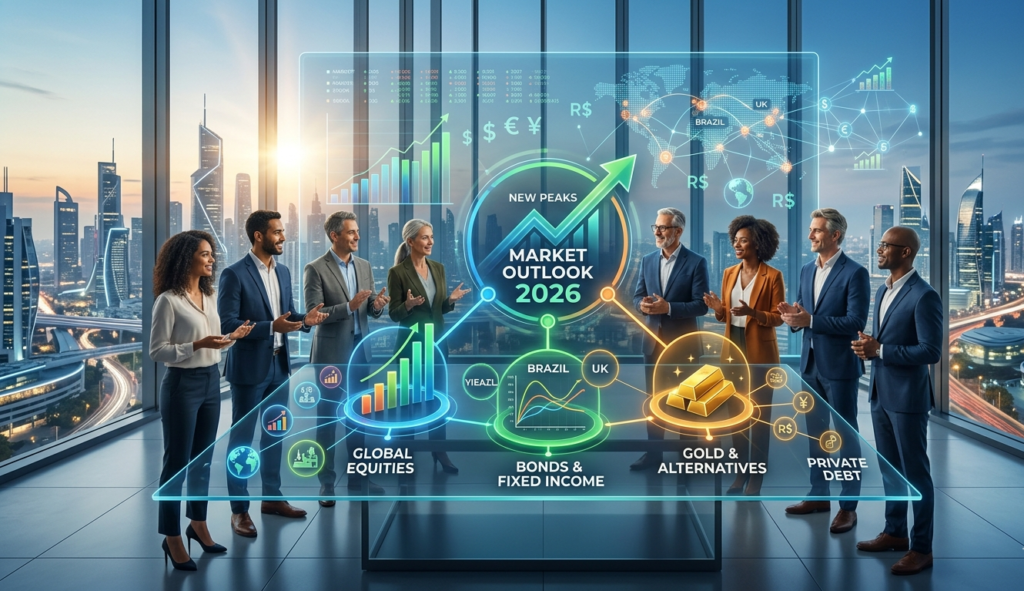
Let’s break down the three key pillars of investment growth shaping winning portfolios right now—and how you can take advantage of them.
The Big Shift: From Defense to Strategic Diversification
In the past few years, investors focused heavily on:
- Capital preservation
- Defensive assets
- Risk avoidance
Now? The mindset is shifting.
With central banks moving toward neutral interest rates—but at different speeds across regions—we’re seeing what experts call a:
“Window of Divergence”
This simply means:
Different countries = different opportunities.
And if you’re paying attention, this opens the door to higher returns with smarter allocation.
1. Global Equities: The Rise of the “Great Broadening”
For a long time, the market story was dominated by a handful of U.S. tech giants.
But in 2026? That narrative is changing—fast.
What’s happening now:
Growth is expanding globally
We’re seeing strong performance outside the U.S., especially in:
- Eurozone markets → benefiting from stabilized energy prices
- Emerging markets → boosted by commodity demand
- Latin America → gaining traction with foreign investment inflows
Earnings Are Driving the Market
Corporate earnings—especially in Europe—are growing at double-digit rates.
And here’s the key insight:
Strong earnings justify higher valuations.
So that fear of “overpriced markets”?
Not always accurate.
Emerging Markets Are Back
With a weaker dollar cycle, regions like Latin America are becoming highly attractive.
- Commodity exports are rising
- Capital inflows are increasing
- Growth potential is expanding
Investment Takeaway
Stay overweight in global equities, but diversify beyond big tech.
Look into:
- Industrial automation
- European consumer sectors
- Emerging market opportunities
The growth story is no longer concentrated—it’s spreading.
2. Fixed Income: Finding Yield in a Fragmented World
Let’s be real—fixed income isn’t boring anymore.
In 2026, bonds are all about strategy and positioning.
The End of “One-Size-Fits-All”
Different countries are following different monetary paths.
That means:
You can’t treat all bonds the same.
🇬🇧 🇧🇷 The Carry Trade Opportunity
Two standout regions right now:
United Kingdom:
- High yields among developed markets
- Stable monetary policy
- Strong hedge against volatility
Brazil:
- High interest rates (Selic)
- Cooling inflation
- Potential for capital gains when rates drop
This is where smart investors are focusing.
Eurozone Credit: A Hidden Opportunity
Investment-grade corporate bonds in Europe are offering:
- Attractive yields
- Lower risk compared to the past
- Strong corporate balance sheets
Some analysts even call this a “once-in-a-decade” opportunity.
Investment Takeaway
To maximize returns in fixed income:
- Focus on regional differences
- Look beyond government bonds
- Explore corporate credit opportunities
Yield is out there—you just need to know where to look.
3. Gold & Alternative Investments: Building a Resilient Portfolio
Let’s talk protection.
Because even in a growing economy, risks haven’t disappeared.
Geopolitics Is the New Normal
Global tensions, trade shifts, and political uncertainty are still part of the picture.
And that’s where gold comes in.
Why Gold Still Matters
Gold is no longer just a “safe asset”—it’s becoming a strategic hedge.
Key drivers:
- Central banks increasing gold reserves
- Reduced reliance on fiat currencies
- Long-term price support
In simple terms: demand is strong and steady.
The Rise of Private Debt
Here’s something many investors overlook:
Private markets are booming.
Especially:
- European private debt
- Illiquidity premium opportunities
By investing in private assets, you can:
- Earn higher returns
- Reduce market volatility exposure
- Beat inflation over time
Investment Takeaway
Build a “crisis-resistant” core with:
- Gold exposure
- Alternative assets
- Private market investments
- Diversification here is your safety net.
Why the Classic 60/40 Portfolio Is Evolving
The traditional portfolio:
- 60% stocks
- 40% bonds
Still works… but it’s no longer enough.
Today’s market requires:
- Broader diversification
- Exposure to private assets
- Dynamic allocation strategies
The future is more flexible, more global, and more data-driven.
The Role of Capital Market Assumptions (CMAs)
This is where things get more advanced.
Capital Market Assumptions (CMAs) help investors:
- Estimate future returns
- Understand risk relationships
- Optimize asset allocation
In 2026, CMAs are evolving to include:
- Public + private asset correlations
- Macroeconomic divergence
- Structural growth trends
In other words: smarter models = better decisions.
Common Mistakes Investors Should Avoid
Even in a strong market, mistakes happen:
- Over-concentration in one region (especially U.S.)
- Ignoring emerging markets
- Avoiding bonds due to outdated assumptions
- Skipping alternative investments
Diversification isn’t optional anymore—it’s essential.
FAQs
Is 2026 a good year to invest in stocks?
Yes, especially with global growth expanding beyond the U.S.
Are bonds still worth it?
Absolutely—especially when focusing on high-yield and regional opportunities.
Why is gold important now?
Because of geopolitical uncertainty and central bank demand.
What are alternative investments?
Assets like private debt, real estate, and hedge strategies outside traditional markets.
What is the biggest trend in 2026 investing?
Global diversification and multi-asset strategies.
Final Thoughts
The global economy in 2026 isn’t slowing down—it’s evolving.
And that means one thing for investors:
You need to evolve too.
The winning strategy today isn’t about playing safe—it’s about being smart, diversified, and globally aware.
- Equities are expanding beyond tech
- Fixed income is becoming strategic again
- Alternatives are no longer optional
This isn’t the end of a cycle—it’s the beginning of a new one.
So the real question is:
Are you positioned for what’s next?