The financial landscape across North America is on the cusp of a profound transformation, driven by the burgeoning concept of Open Banking. This paradigm shift promises to empower consumers with greater control over their financial data, foster innovation, and intensify competition within the financial services sector. For individuals and businesses in Canada and the United States, understanding the intricacies of Open Banking—its current status, regulatory frameworks, and potential impacts—is crucial. This extensive guide will delve into the financial revolution unfolding in both nations, providing a comprehensive overview for the informed investor and consumer.
What is Open Banking?
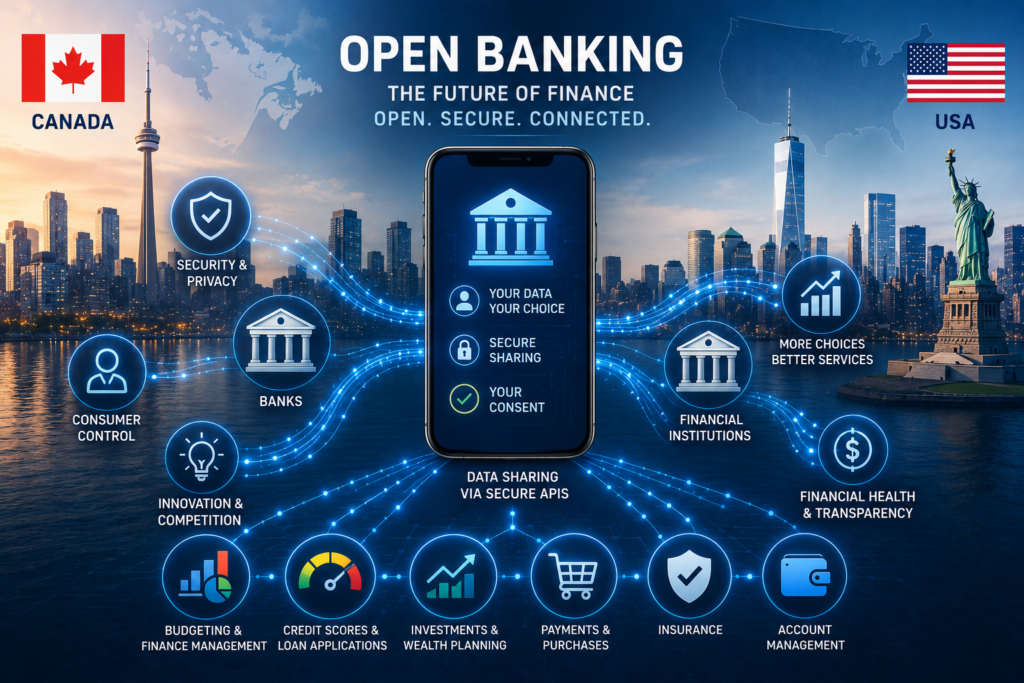
At its core, Open Banking is a system that allows third-party financial service providers to access consumer banking data (with explicit consent) from banks and other financial institutions. This access is typically facilitated through secure Application Programming Interfaces (APIs), enabling a seamless and secure exchange of information. The primary goals are to:
•Enhance Consumer Control: Give individuals ownership of their financial data.
•Promote Innovation: Encourage fintech companies to develop new and improved financial products and services.
•Increase Competition: Break down barriers to entry for new players, leading to better offerings and lower costs for consumers.
•Improve Financial Wellness: Provide tools for better budgeting, personalized advice, and more efficient financial management.
Open Banking in Canada: A Phased Approach to Consumer-Driven Banking
Canada has been steadily moving towards a consumer-driven banking framework, with significant legislative and regulatory developments in 2024 and 2025.
Legislative Milestones
The journey towards Open Banking in Canada gained substantial momentum with the passing of the Consumer-Driven Banking Act in June 2024. This landmark legislation laid the groundwork for a system where Canadians can securely share their financial data with trusted third-party providers. Further commitment and funding for its implementation were outlined in Budget 2025.
Implementation Timeline and Framework
The Canadian government is actively developing a secure framework, with the full implementation of Open Banking expected to launch in early 2026 . This framework is meticulously designed to address critical aspects such as:
•Governance: Establishing clear rules and responsibilities for all participants.
•Scope: Defining what data can be shared and under what conditions.
•Accreditation: Setting standards for third-party providers to ensure security and trustworthiness.
•Technical Standards: Mandating secure API protocols for data exchange, moving away from less secure methods like screen scraping.
The Financial Consumer Agency of Canada (FCAC) plays a pivotal role in overseeing the development and implementation of this framework, ensuring consumer protection remains paramount.
Benefits for Canadian Consumers
Once fully operational, Open Banking in Canada is expected to unlock a wealth of benefits:
•Personalized Financial Management: Access to budgeting apps that provide a holistic view of finances across multiple institutions.
•Streamlined Loan Applications: Faster and more accurate credit assessments through secure data sharing.
•Innovative Investment Tools: New platforms offering tailored investment advice and portfolio management.
•Easier Account Switching: Simplified process for moving accounts between financial institutions.
Open Banking in the USA: Navigating a Complex Regulatory Landscape
The United States’ approach to Open Banking, often referred to as “consumer financial data rights,” has been driven primarily by the Consumer Financial Protection Bureau (CFPB) under Section 1033 of the Dodd-Frank Act.
Regulatory Developments
In October 2024, the CFPB issued a Final Rule for the Required Rulemaking on Personal Financial Data Rights under Section 1033. This rule aimed to grant consumers the right to access their financial data and share it with third parties. However, the implementation has faced challenges.
In July 2025, the CFPB’s Section 1033 rule was stayed, and the Bureau initiated new rulemaking, inviting comments on various aspects of the rule in August 2025. This indicates a dynamic and evolving regulatory environment, with ongoing efforts to refine the framework for secure data sharing.
Moving Beyond Screen Scraping
A key objective of the CFPB’s efforts is to transition the industry away from less secure methods like “screen scraping”—where consumers provide their banking login credentials to third-party apps—towards a more secure, API-based data exchange model. This shift is critical for enhancing data security and privacy for American consumers.
Potential Impact on American Consumers and Fintech
Despite the regulatory complexities, the push for consumer financial data rights in the US holds immense potential:
•Enhanced Competition: By making it easier for consumers to share their data, fintech companies can compete more effectively with traditional banks, leading to better products and services.
•Improved Financial Tools: Consumers can benefit from a new generation of personal finance management apps, budgeting tools, and lending services that offer more accurate and personalized insights.
•Greater Transparency: Increased visibility into how financial data is used and shared.
•Seamless Integration: Easier connection of various financial accounts for a consolidated view of one’s financial health.
Key Differences and Similarities: Canada vs. USA
While both nations are moving towards greater consumer control over financial data, their paths differ:
| Feature | Canada (Consumer-Driven Banking) | USA (Consumer Financial Data Rights) |
| Primary Driver | Government-led legislative framework | Regulator-led (CFPB) rule-making under existing law |
| Legislative Status | Consumer-Driven Banking Act passed (June 2024) | Section 1033 Final Rule (Oct 2024), but stayed and under reconsideration (July/Aug 2025) |
| Implementation | Phased approach, framework expected early 2026 | Evolving, with ongoing rulemaking and industry adaptation |
| Focus | Comprehensive framework (governance, scope, accreditation, technical standards) | Data access rights, moving from screen scraping to APIs |
| Regulatory Body | FCAC (Financial Consumer Agency of Canada) | CFPB (Consumer Financial Protection Bureau) |
Despite these differences, the overarching goal in both countries is similar: to empower consumers, foster innovation, and create a more competitive and efficient financial ecosystem.
The Future of Finance: Opportunities and Challenges
Open Banking, or consumer-driven banking, represents a significant leap forward in financial technology. However, its implementation is not without challenges:
Opportunities
•Hyper-Personalized Services: Financial products and advice tailored precisely to individual needs and behaviors.
•Cross-Border Financial Management: Easier management of finances for individuals and businesses operating across the Canada-US border.
•Financial Inclusion: New services can reach underserved populations by leveraging alternative data sources.
•Enhanced Security: The shift to secure APIs will significantly reduce the risks associated with sharing financial data.
Challenges
•Data Privacy and Security: Ensuring robust safeguards against data breaches and misuse remains paramount.
•Interoperability: Developing common standards for data exchange across diverse financial institutions.
•Consumer Education: Educating consumers about their data rights and the benefits and risks of sharing their financial information.
•Regulatory Harmonization: Coordinating efforts between different regulatory bodies to create a consistent and effective framework.
Conclusion
Open Banking is more than just a technological upgrade; it is a fundamental re-imagining of the relationship between consumers, financial institutions, and third-party innovators. Both Canada and the United States are actively shaping their respective frameworks, albeit through different regulatory pathways. For investors and consumers in North America, staying informed about these developments is key to harnessing the power of this financial revolution. The era of consumer-driven finance is here, promising a future of greater choice, innovation, and control over one’s financial destiny.
References
[1] DLA Piper. (2026, April 22). The new Consumer‑Driven Banking Act explained.
[2] MX Technologies. (2024, December 19). Canada’s Open Banking Framework Takes Shape.
[3] McMillan. (2025, November 18). Canada’s Open Banking Framework: Key Updates from Budget 2025.
[4] DLA Piper. (2025, April 24). Introduction to open banking in Canada.
[5] Canada.ca. (2025, December 16). Open banking.
[6] Global Risk Institute. (2025, January 9). Brief on Canada’s Open Banking Framework.
[7] Canada.ca. (2025, November 6). Budget 2025: Canada’s Consumer-Driven Banking Framework.
[8] Sidley. (2024, October 28). CFPB Releases Final Rule on Personal Financial Data Rights.
[11] Federal Register. (2025, August 22). Personal Financial Data Rights Reconsideration.