Artificial Intelligence is no longer a futuristic concept reserved for science fiction movies or tech laboratories. Today, AI is actively reshaping industries around the world — and education is becoming one of the sectors experiencing the greatest transformation.
From personalized learning experiences to intelligent tutoring systems, AI is redefining how students learn, how teachers teach, and how educational institutions operate. More importantly, this technological revolution has the potential to make high-quality education more accessible, inclusive, and effective for people from all backgrounds.
In this article, we’ll explore how AI-powered education is changing the future of learning, the benefits and challenges involved, and why educators, parents, and students should pay attention to this growing movement.
What Is AI in Education?
Artificial Intelligence in education refers to the use of machine learning algorithms, data analysis, natural language processing, and automation technologies to improve educational experiences and outcomes.
Instead of using the traditional “one-size-fits-all” teaching model, AI enables educational systems to adapt dynamically to each student’s unique needs, pace, strengths, and weaknesses.
This means students can receive customized learning experiences that are more engaging, efficient, and personalized than ever before.
As digital learning platforms continue to evolve, AI is becoming a central pillar of modern education strategies worldwide.
Personalized Learning: The End of Generic Education
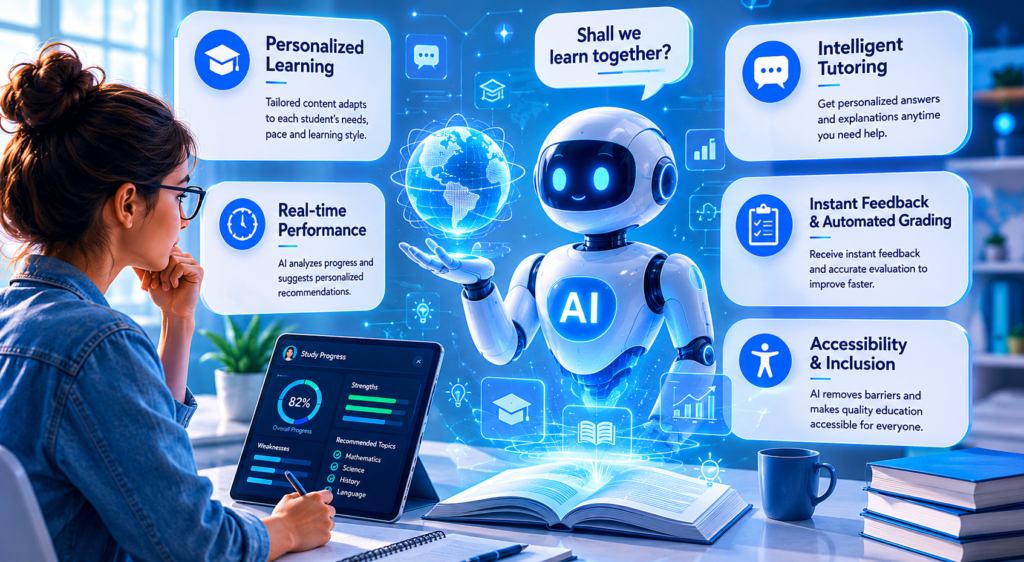
One of the biggest breakthroughs AI brings to education is personalized learning.
Traditional classrooms often struggle to accommodate different learning speeds and styles. Some students advance quickly, while others require additional support. Unfortunately, teachers frequently lack the time and resources necessary to personalize instruction for every individual student.
AI changes this completely.
Using adaptive learning systems, AI can analyze student performance in real time and adjust lessons accordingly. If a student struggles with a concept, the platform can automatically provide additional exercises, explanations, or alternative teaching methods. If the student masters the material quickly, the system can introduce more advanced content.
This creates a learning environment tailored specifically to each learner.
Benefits of Personalized AI Learning
- Increased student engagement
- Better knowledge retention
- Faster identification of learning difficulties
- Improved academic performance
- Reduced frustration and burnout
- Greater student confidence and motivation
Platforms powered by AI are helping students learn more efficiently while allowing teachers to focus on higher-value interactions and mentorship.
AI-Powered Tutoring Systems Are Expanding Access to Education
Intelligent tutoring systems are another major innovation transforming education.
These virtual tutors simulate one-on-one instruction by offering personalized guidance, instant explanations, and interactive support 24 hours a day.
Unlike traditional tutoring, AI tutoring systems are scalable and accessible to millions of students simultaneously. This is particularly valuable for students living in remote areas or for individuals who cannot afford private tutoring services.
AI tutors can:
- Answer student questions instantly
- Identify gaps in understanding
- Recommend personalized study plans
- Adapt explanations based on student comprehension
- Provide continuous learning support outside the classroom
As these systems continue to evolve, they are becoming increasingly human-like in communication and interaction quality.
Automated Grading and Instant Feedback
Teachers spend a significant amount of time grading assignments, tests, and essays. AI is helping reduce this administrative burden through automated grading systems.
These technologies can evaluate multiple-choice tests, written responses, and even certain forms of essays with impressive accuracy.
But the real advantage goes beyond automation.
AI can provide immediate and detailed feedback, allowing students to correct mistakes and improve faster. Instead of waiting days or weeks for results, learners can receive actionable insights instantly.
This creates a more dynamic and responsive learning process.
Why Instant Feedback Matters
Immediate feedback helps students:
- Correct misunderstandings quickly
- Stay motivated
- Build consistent learning habits
- Improve performance through repetition
- Develop self-awareness about learning patterns
Meanwhile, educators gain more time to focus on teaching strategy, creativity, and student development.
Natural Language Processing Is Making Learning More Human
Natural Language Processing (NLP) — a branch of AI focused on human language understanding — is revolutionizing educational interactions.
AI systems can now understand text, speech, and even emotional cues with increasing accuracy.
Modern educational platforms use NLP to:
- Enable conversational learning experiences
- Power AI chat assistants for students
- Translate content in real time
- Improve accessibility for multilingual learners
- Detect emotional frustration or confusion during lessons
This technology helps create more interactive and empathetic digital learning environments.
In the near future, AI educational assistants may become as common as calculators or textbooks in classrooms around the world.
AI and Accessibility: Education for Everyone
One of the most powerful impacts of AI in education is its potential to increase accessibility and inclusion.
Students with disabilities often face barriers that traditional education systems struggle to address effectively. AI-driven technologies can help remove many of these obstacles.
Examples include:
- Real-time speech-to-text transcription
- AI-generated subtitles and translations
- Voice-controlled educational interfaces
- Personalized support for students with learning disabilities
- Adaptive reading tools for visually impaired learners
By making learning environments more inclusive, AI can help millions of students participate more fully in education.
This represents a major step toward educational equality.
How AI Helps Teachers Become More Effective
Contrary to popular fears, AI is not replacing teachers.
Instead, it is becoming a powerful tool that enhances teacher effectiveness.
AI analytics platforms can provide educators with valuable insights about:
- Student performance trends
- Engagement levels
- Learning gaps
- Classroom participation
- Teaching effectiveness
These data-driven insights allow teachers to make better instructional decisions and identify struggling students earlier.
AI can also automate repetitive administrative tasks, freeing educators to focus on what matters most: inspiring, mentoring, and connecting with students.
The future of education is likely to be a collaboration between human educators and intelligent technologies — not a competition between them.
Challenges and Ethical Concerns of AI in Education
Despite its enormous potential, AI in education also presents important challenges.
Some of the main concerns include:
Data Privacy
Educational platforms collect large amounts of student data. Protecting this information is critical.
Algorithm Bias
AI systems can unintentionally reinforce existing inequalities if trained on biased datasets.
Overdependence on Technology
Excessive reliance on AI could reduce human interaction and critical thinking if not implemented carefully.
Digital Divide
Not all students have equal access to internet connectivity, devices, or modern educational technologies.
For AI to truly democratize education, governments, institutions, and technology companies must work together to ensure equitable access and ethical implementation.
The Future of AI in Education
The future of education will likely become increasingly personalized, intelligent, and adaptive.
Emerging technologies may soon include:
- Fully immersive AI-powered virtual classrooms
- Emotion-aware learning systems
- AI-generated custom curricula
- Hyper-personalized career guidance
- Advanced educational simulations using augmented reality and virtual reality
As AI capabilities continue to evolve, education may shift from standardized instruction toward individualized lifelong learning journeys.
This transformation has the potential to unlock human potential on a global scale.
Final Thoughts
Artificial Intelligence is revolutionizing education in ways that were unimaginable just a decade ago.
By enabling personalized learning, improving accessibility, automating repetitive tasks, and providing intelligent support systems, AI is helping create more effective and inclusive educational experiences for students everywhere.
However, technology alone is not the solution.
The true power of AI in education lies in how educators, institutions, and society choose to use it. When implemented responsibly and ethically, AI can become one of the most important tools ever created for expanding human knowledge and opportunity.
The future of learning is not just digital — it is intelligent, adaptive, and deeply personalized.
And this transformation is only beginning.